Latitude: 47.4° north
Weather: -2°C, 🌥️ Sunrise: 07:35 Sunset: 16:52
Time to change countries. Ahead – a weekend in an atmospheric, intriguing city and some lovely family time. Tim’s sister Jo & partner Stephan live near Basel, so after looking at the weather forecast and taking Steph’s expert advice, we settled on St Gallen as our meeting point. A city in north east Switzerland, just south of Lake Constance, it would be easy to get to, looked pretty and famous for its library – very quickly sold.
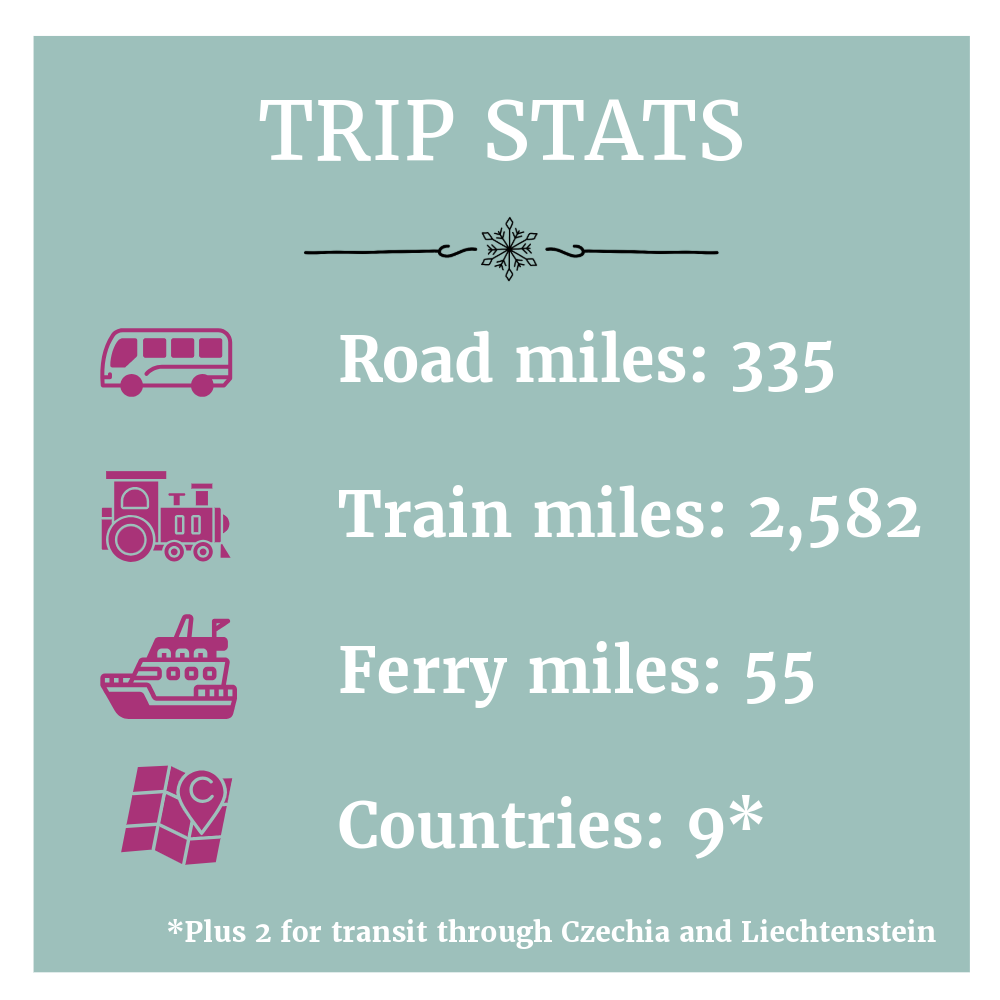
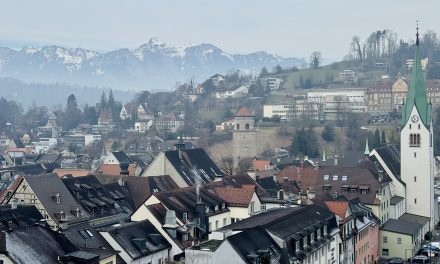
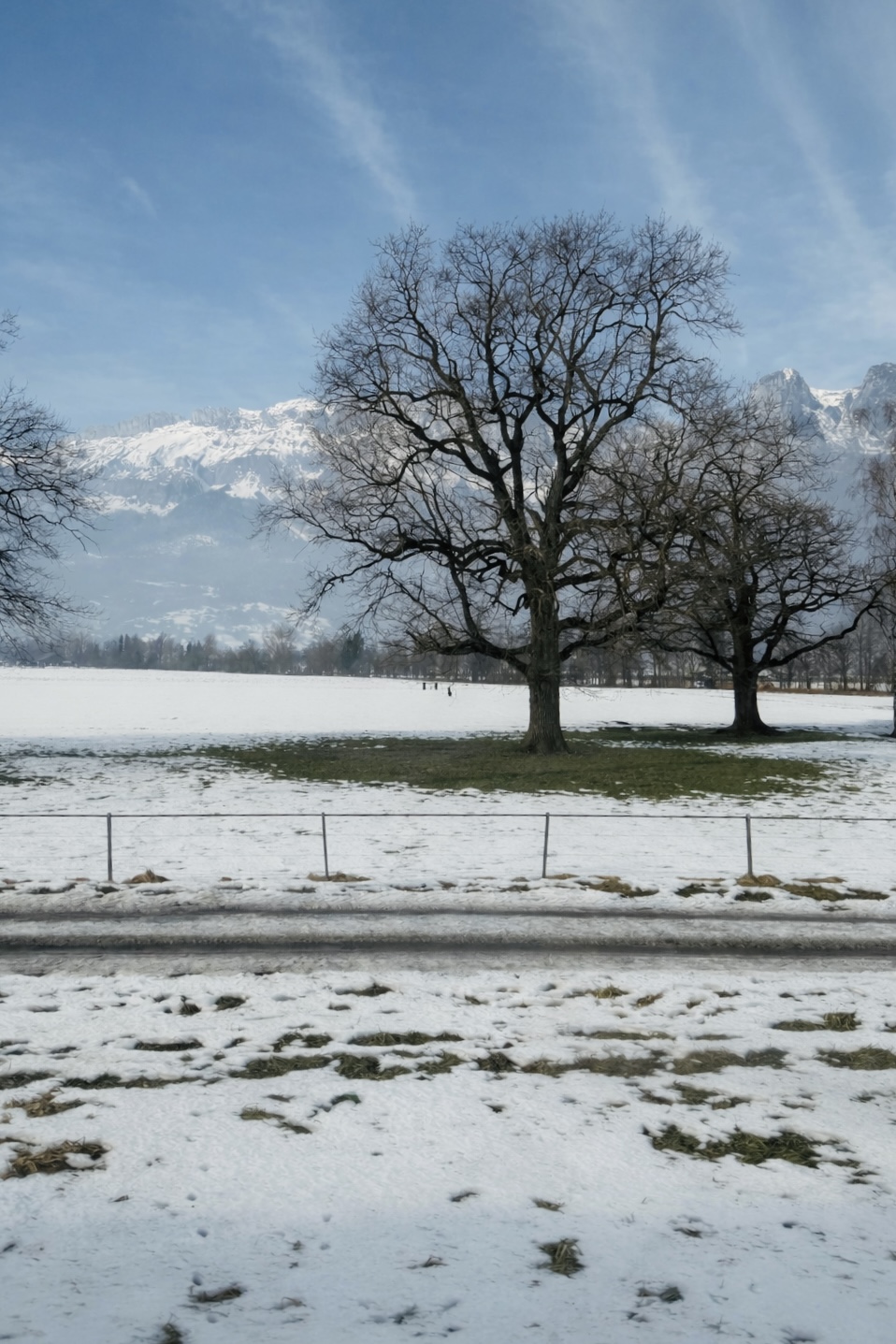
We waved Feldkirch goodbye and enjoyed a gentle train ride meandering along valleys, distant views of hazy mountains. The route sneaked through the top corner of Liechtenstein, earning us an extra transit country, and into Switzerland for our 9th country of the trip.
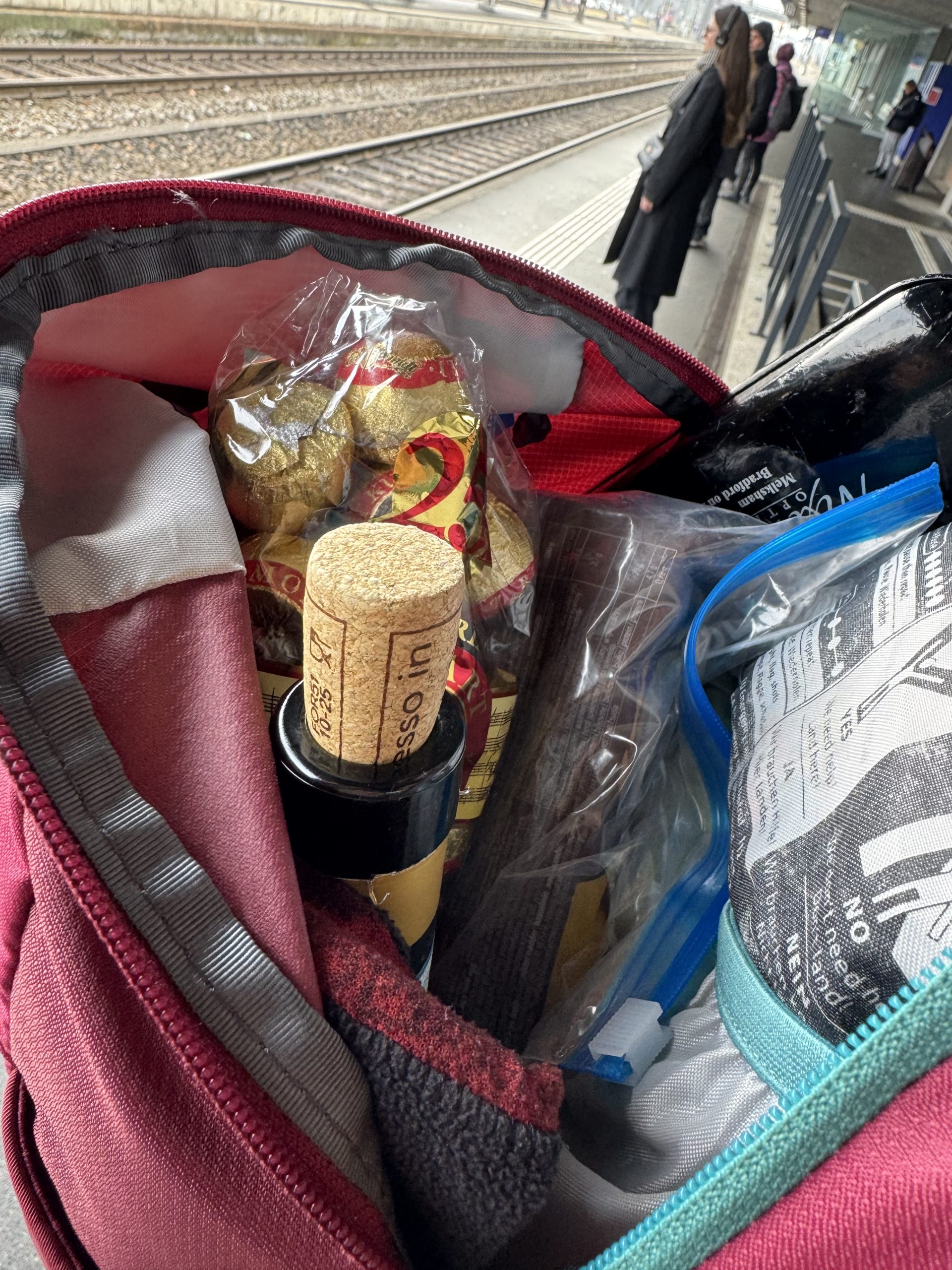
Standing on one of the station platforms along the way, Tim opened his daysack to reveal that he was carrying half a bottle of wine, stopper carefully back in the top, and half a kilo of Mozart balls. I knew there was a reason I love to travel with him.
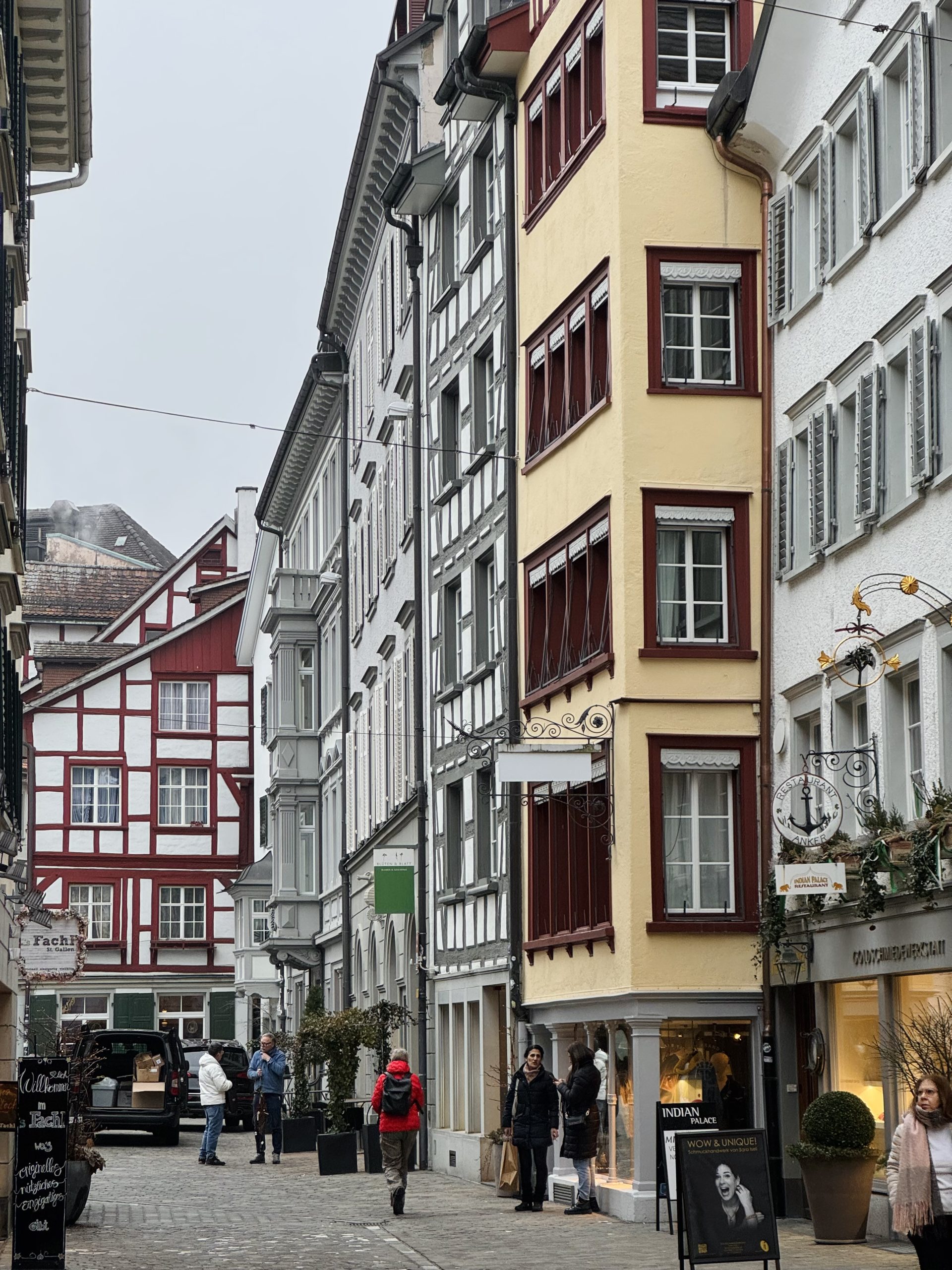
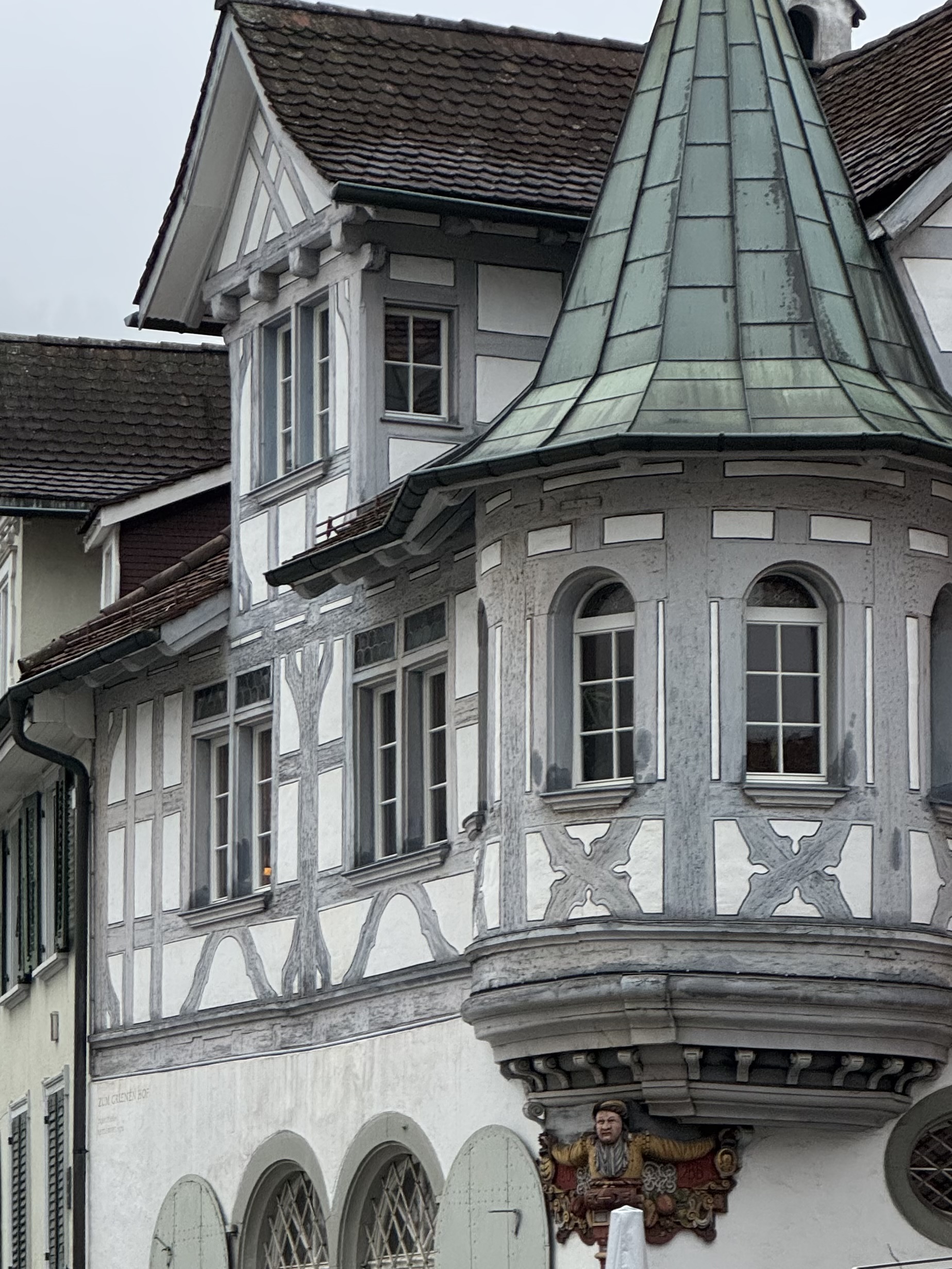
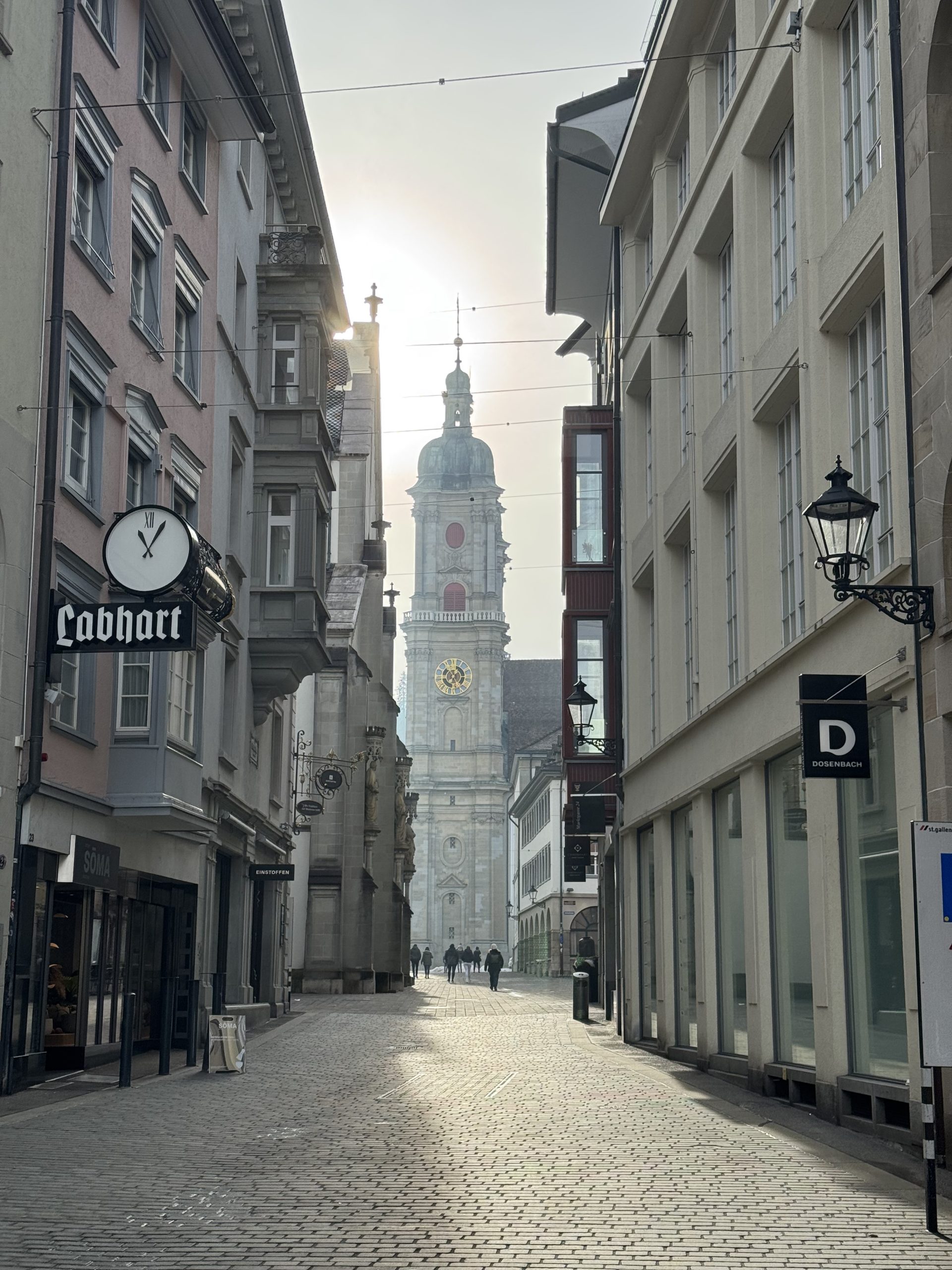
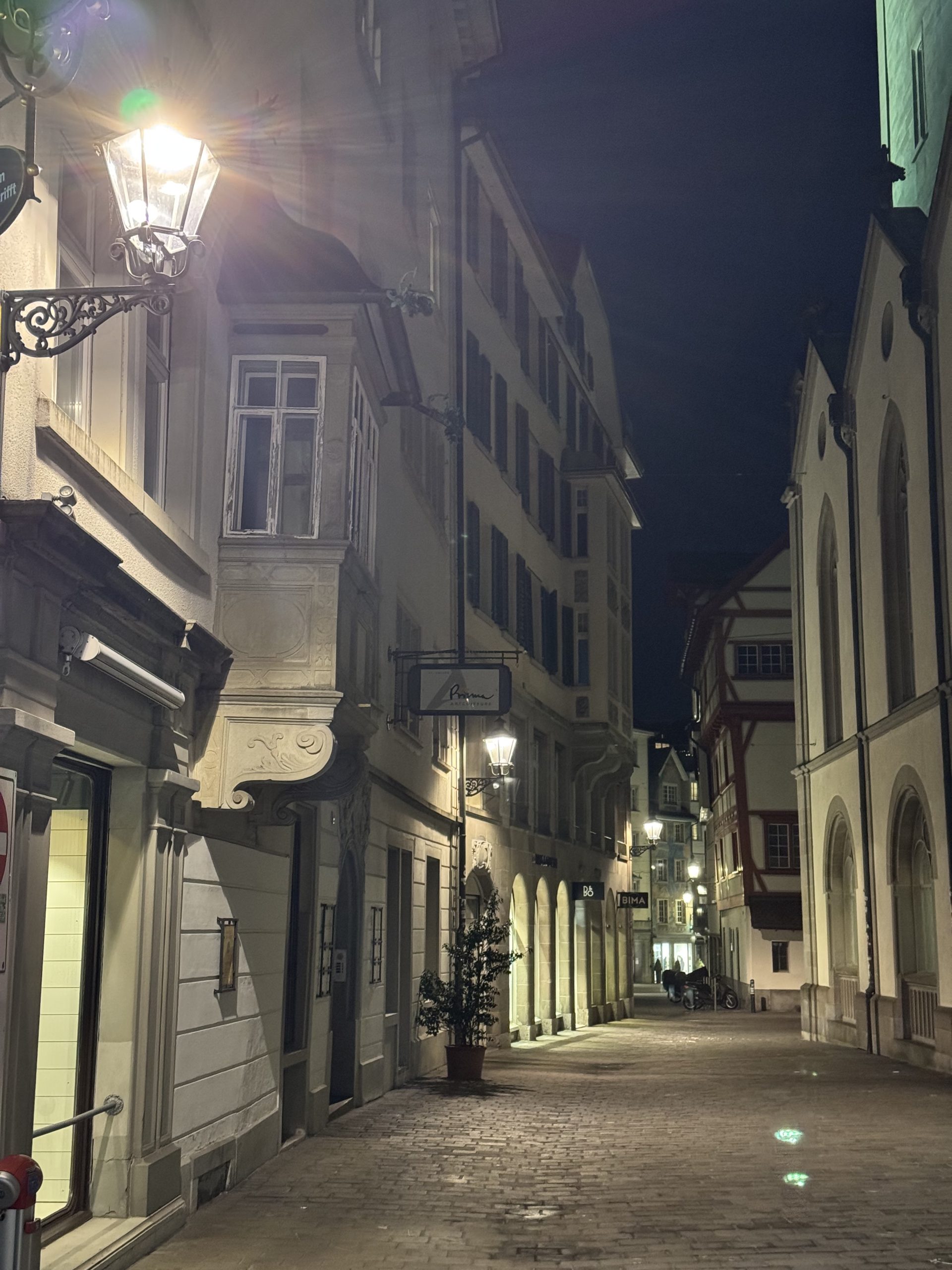
The walk from the station into any new town or city is always the worst way to form an opinion. First impressions of St Gallen were: modern, commercial, smart, full of banks. No snow left at street level except on some grassed areas, so back to walking on easy pavements again. Within 10 minutes’ walk we crossed the tram lines and headed into the city centre. Immediate change. Colourful half-timbered houses, intricate bay windows, colourised shutters – smart fronts, quirky, crooked backs and twisted alleys of cobbled streets. So different from any architecture we’ve seen so far on this trip. At pavement level, cafes, small shops – a smart, enticing town.
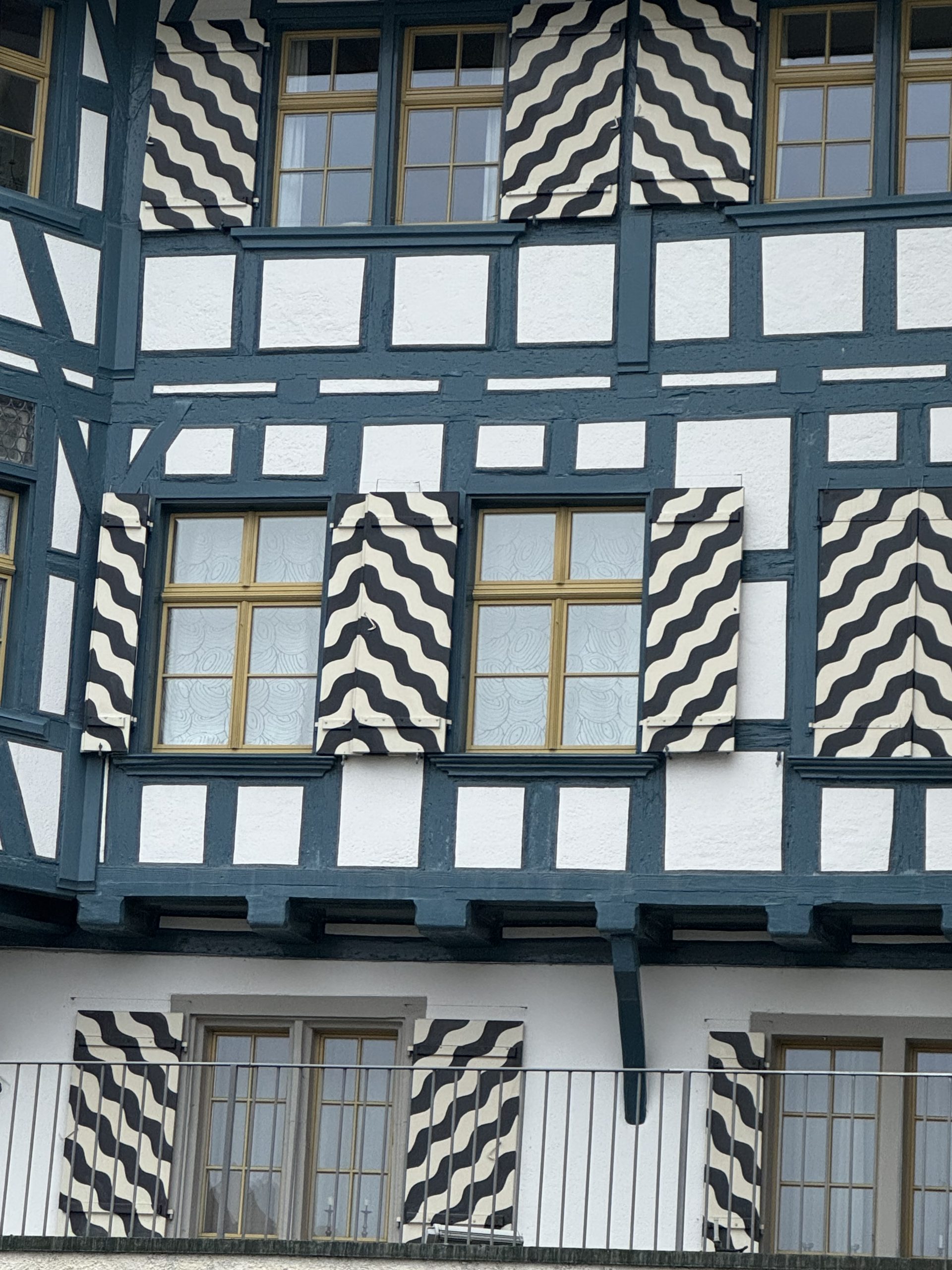
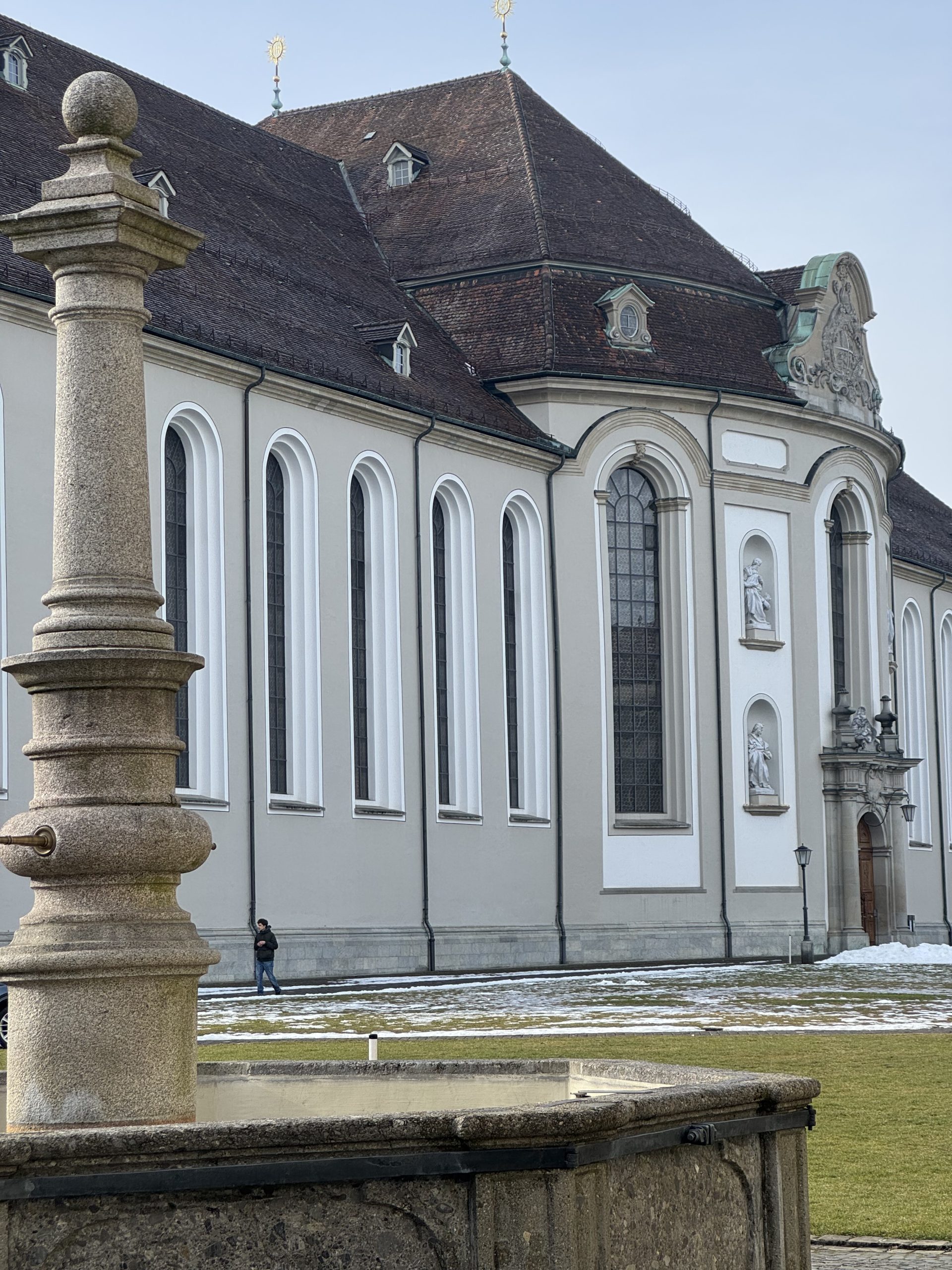
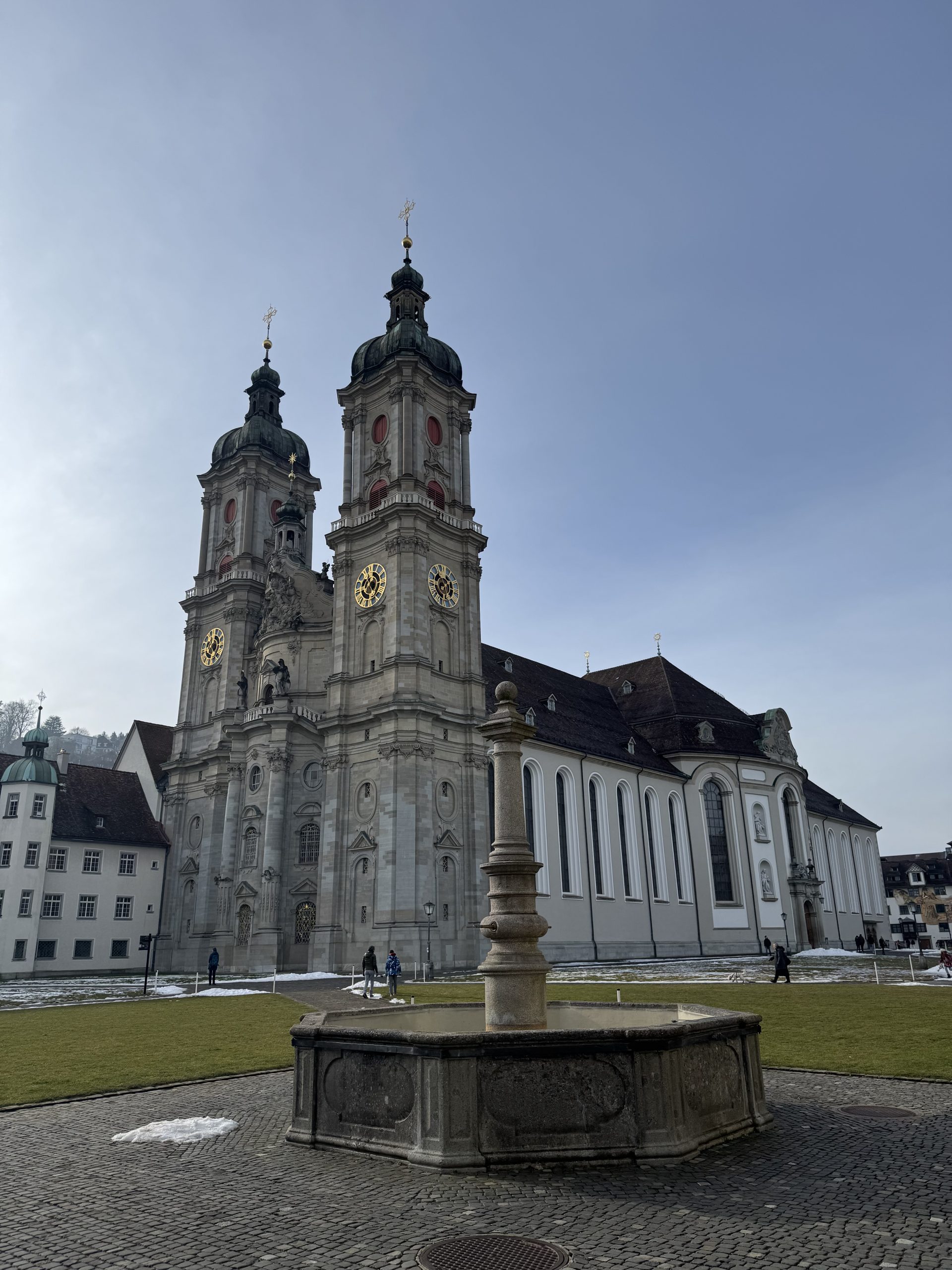
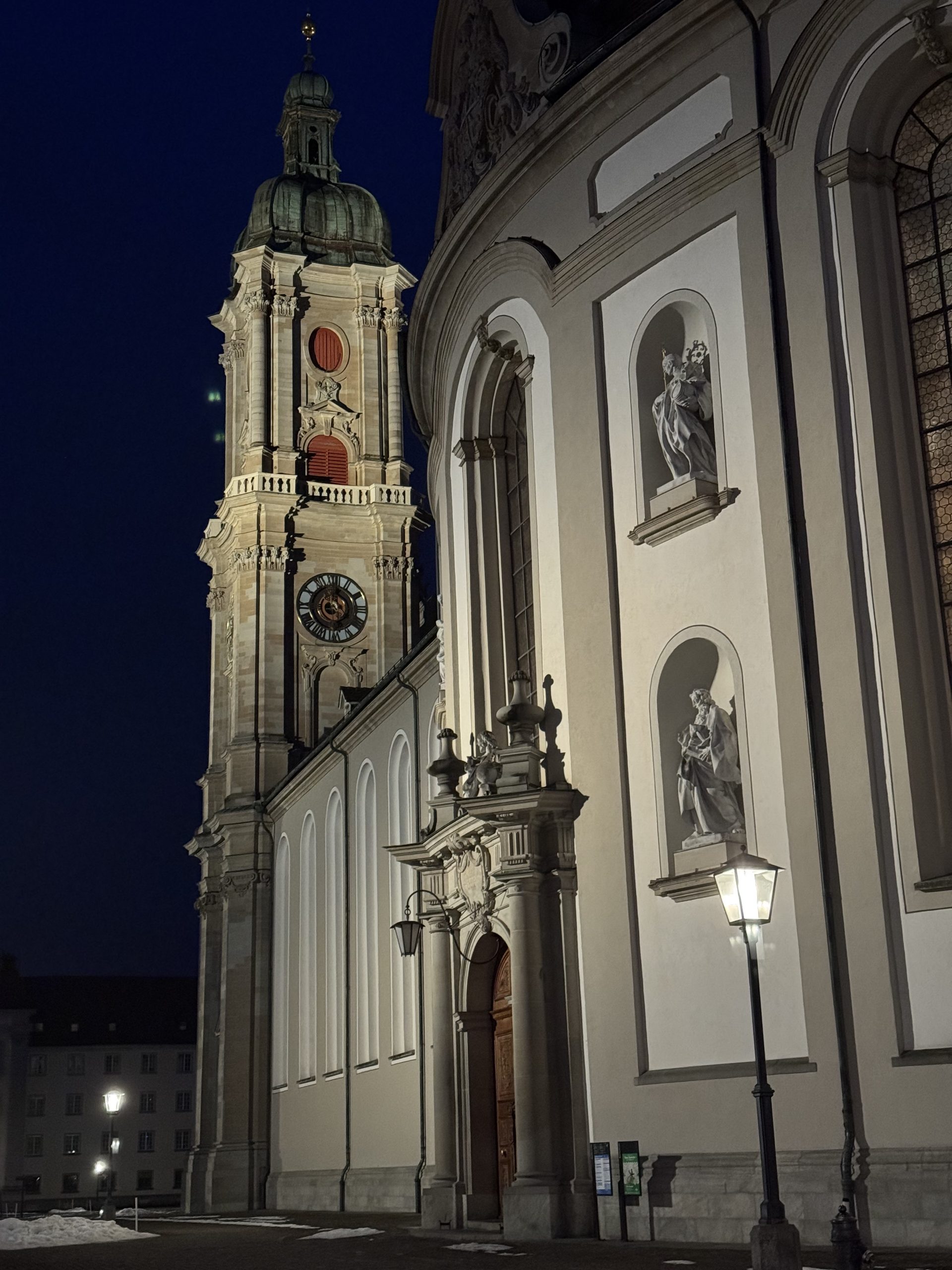
And then you turn a corner, wandering among these classic Swiss buildings, all colourful signs and wonky timber and – wow. In the heart of St Gallen is the huge white-stone Abbey Cathedral. A vast open grassed courtyard, monastery buildings wrapped around one end and the imposing, baroque cathedral building at the side. It’s an astonishing sight – more Rome than Swiss timber.
Meeting up with Jo & Steph, we very gratefully left our rucksacks in their car and headed out for a wander and coffee. A stroll in a lovely town, great conversation and gluten-free apple crumble as the icing on the (literal) cake.
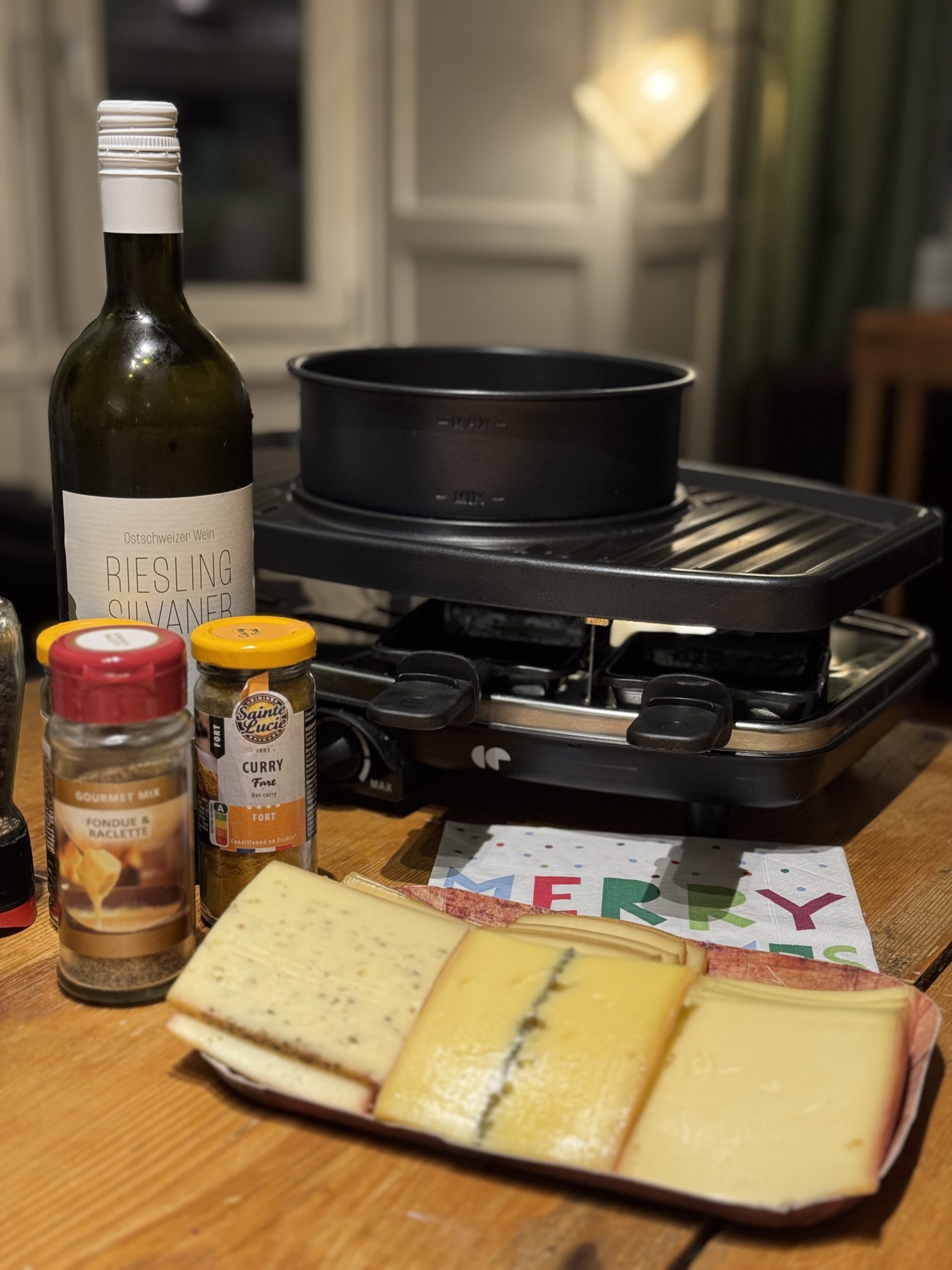
Our Airbnb was up a steep wooden staircase above a foccaceria. We were thoroughly spoilt with a lovely dinner of raclette, wine and Swiss chocolate. The absolute joy of eating food you haven’t had to figure out how to buy and carry with rucksacks on your back – a wonderful thing. Thanks J&S.
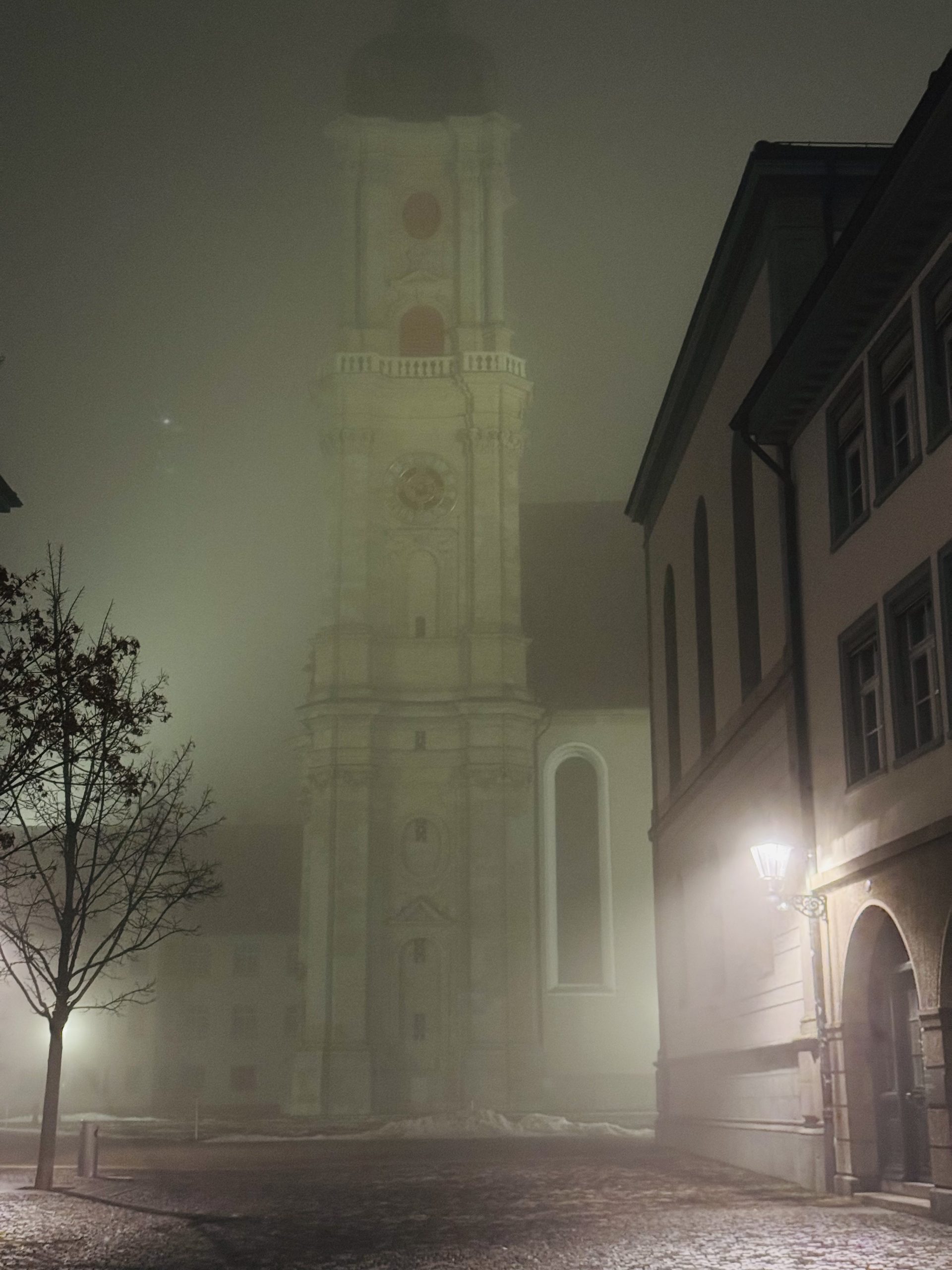
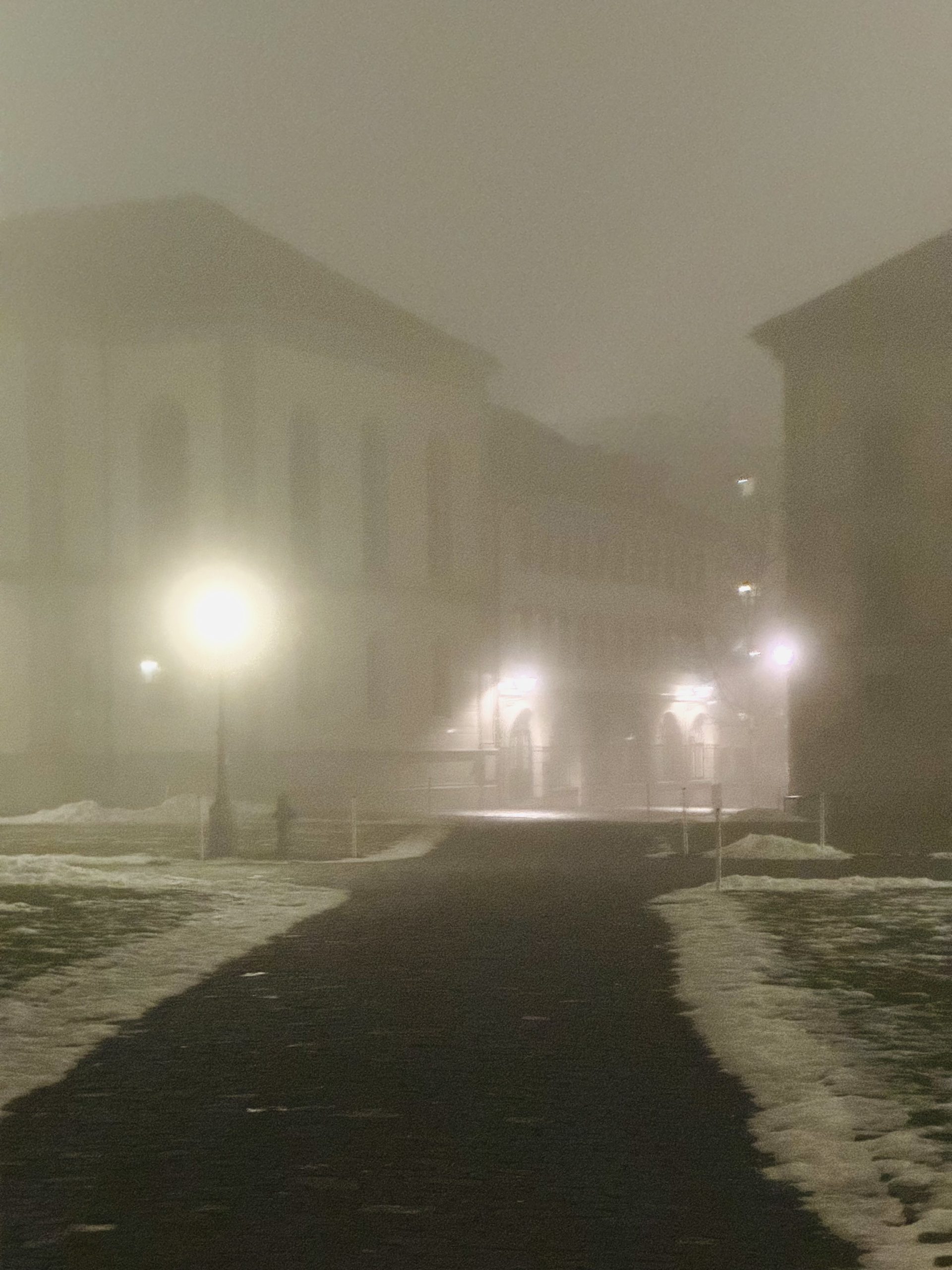
After dinner we headed out to walk off (some of) the cheese. A thick mist was blanketing St Gallen and the city felt wrapped in mystery. The cathedral – no longer visible from a distance, then emerging from the mist as we approached as though only half there. The spotlights in the abbey square cutting through the mist, casting a light that was at once beautiful and a little eerie. I always love the way mist strips all the detail from a scene, taking it back to its most fundamental elements: ground, horizon, trees. In a city it wraps everything in a sense of secrecy and intimacy, and St Gallen on a misty night felt timeless and a little unreal.
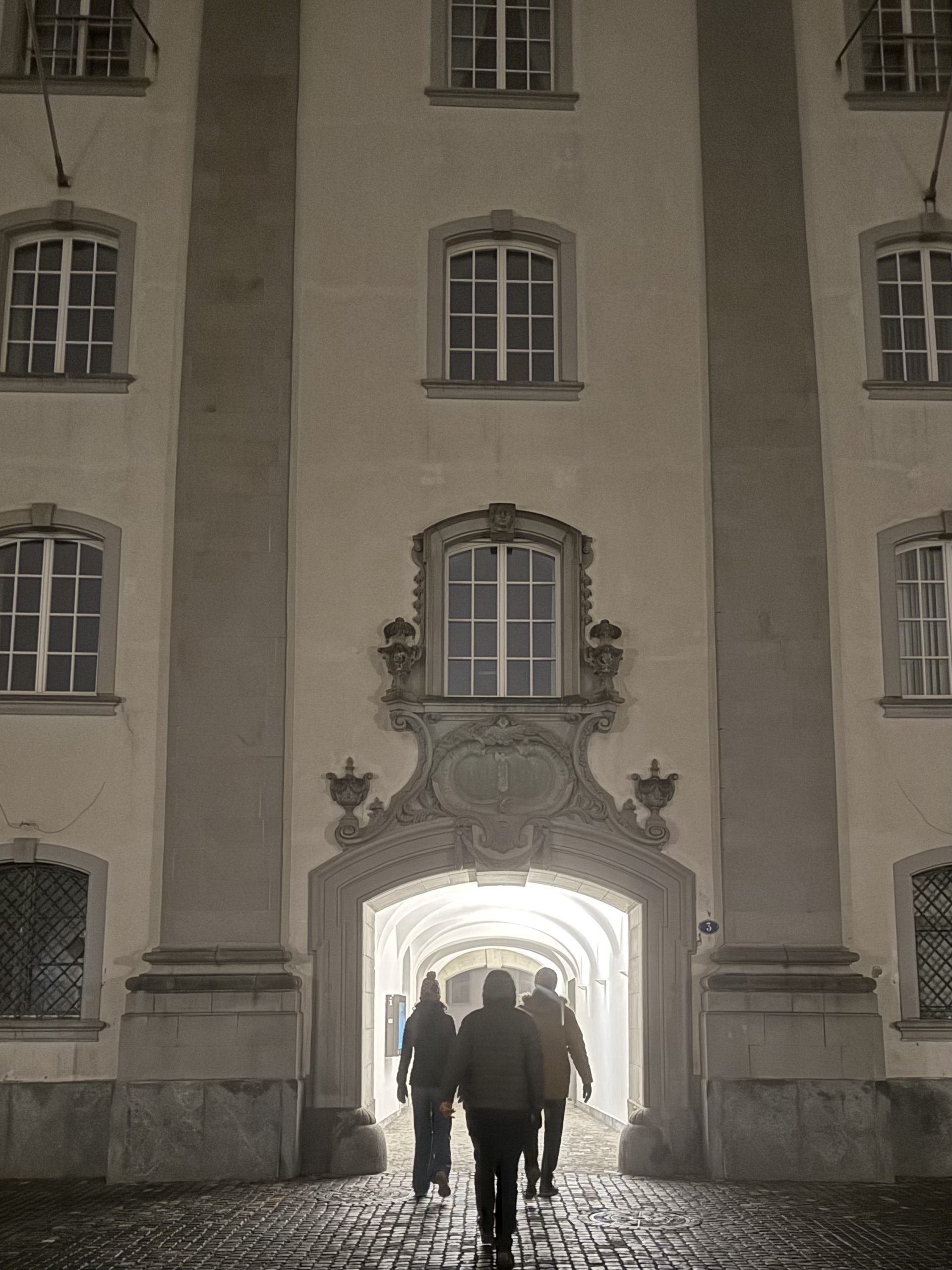
We walked through the cloisters into a courtyard. Here, two dark statues loomed at one side of the courtyard. One of them definitely played with my imagination on a spooky night. It didn’t matter where I moved, his eyes followed me. Remember that detail for later …
I was awake and slightly restless on Sunday morning so headed out on my own for a short walk before breakfast. The bells were tolling at the abbey cathedral as I walked towards it – the sound seeming to echo in to the city from all sides. Empty streets, a city still asleep – except for the abbey. I stood outside and listened to the rumble of the organ which was seeping through the walls, catching fleeting sounds of singing. The abbey courtyard was empty, the mist gone, the world still and – apart from the music within – silent. A peaceful, timeless moment.
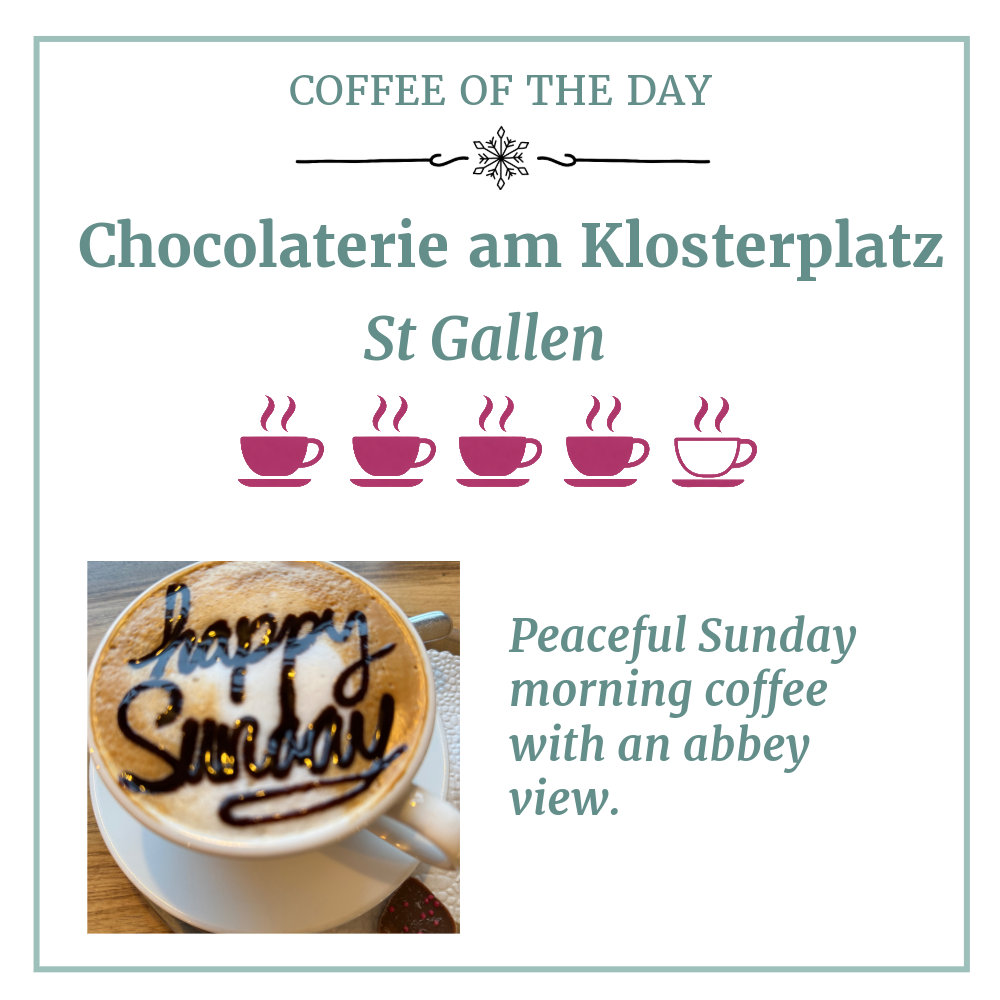
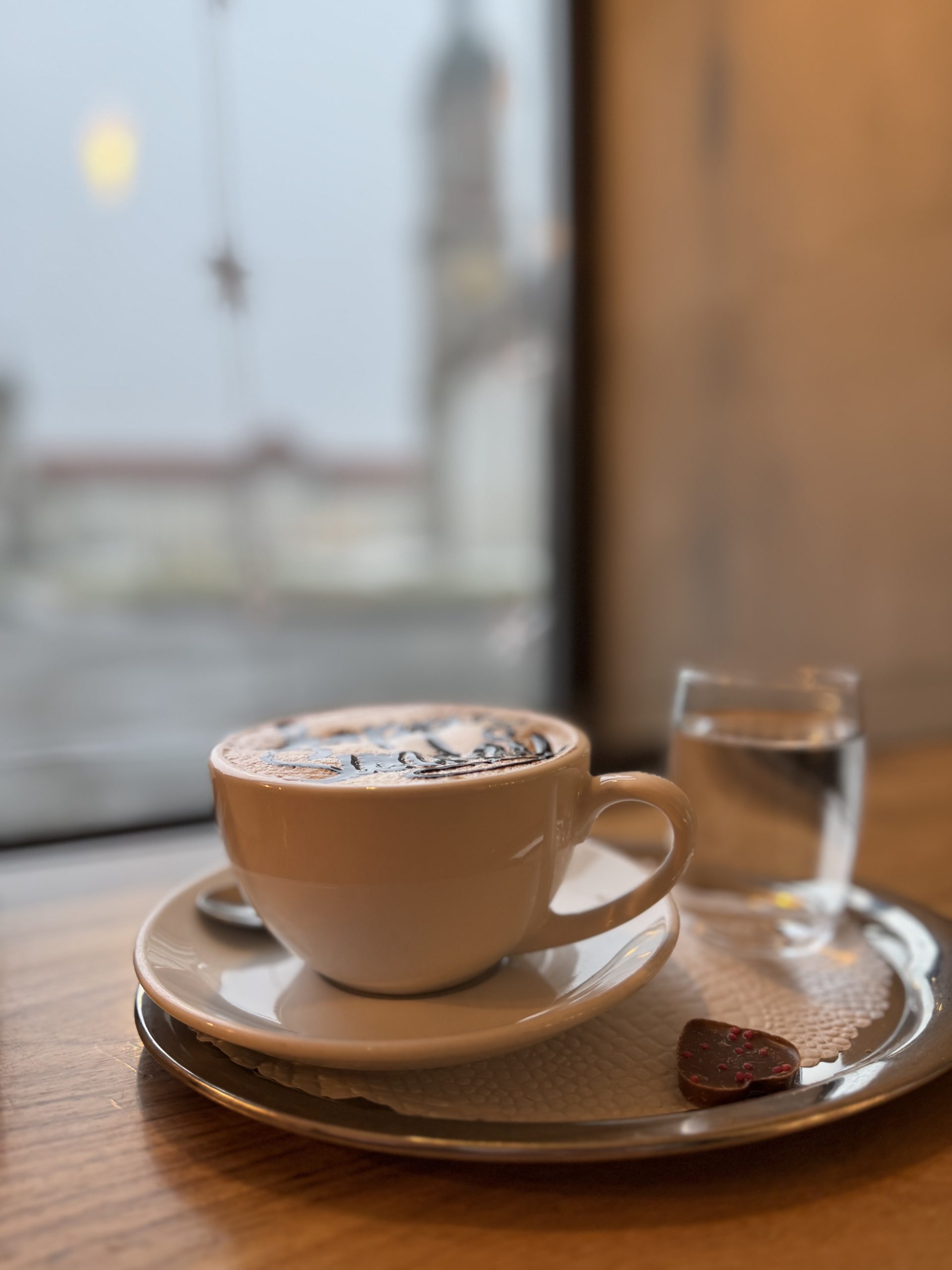
Back in the present there was also a single cafe open across the square, so I sat in the window with a (ruinously expensive but worth it) cappuccino and watched the city start to come to life, taking a little quiet time for myself on a peaceful morning.
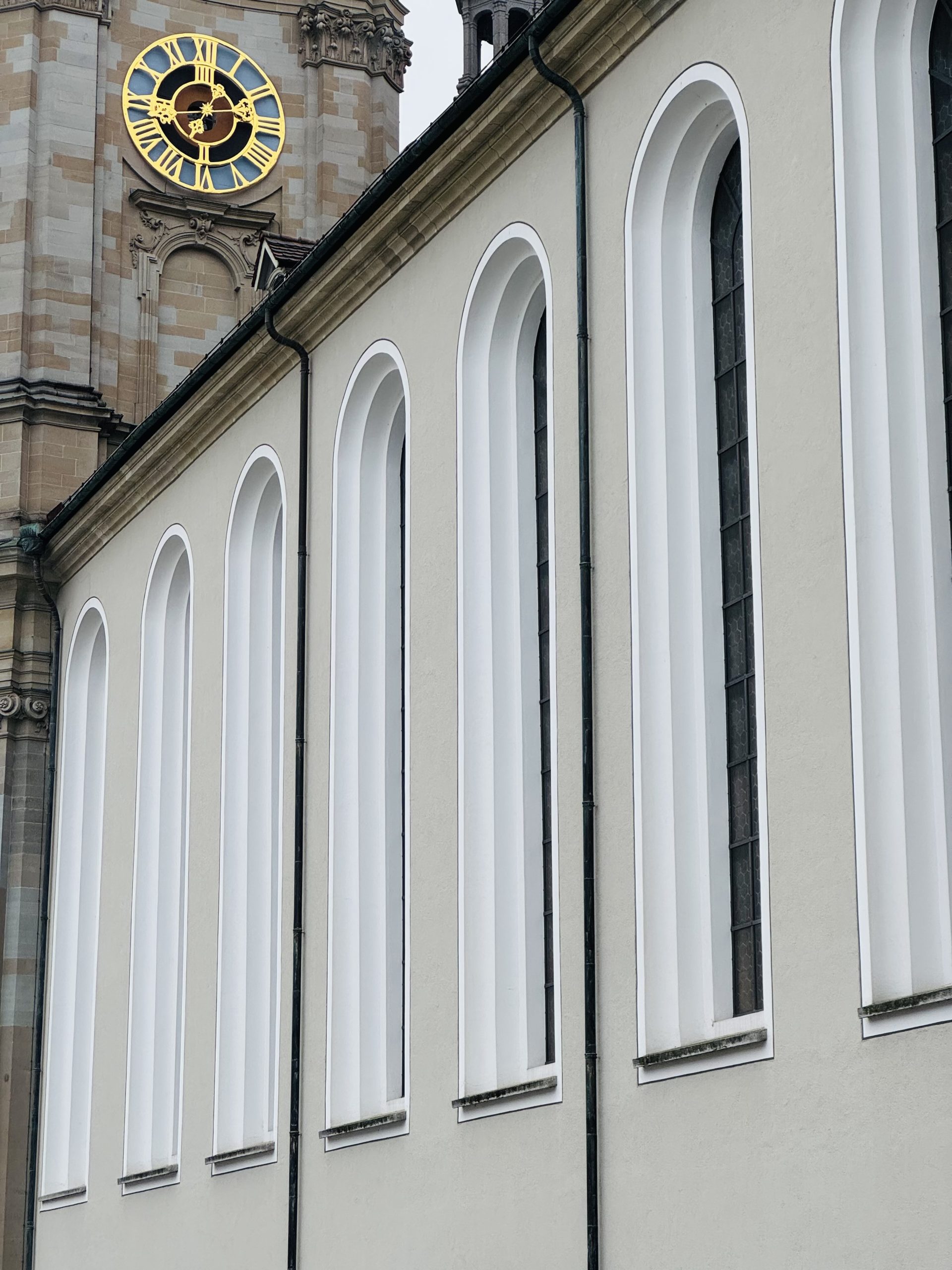
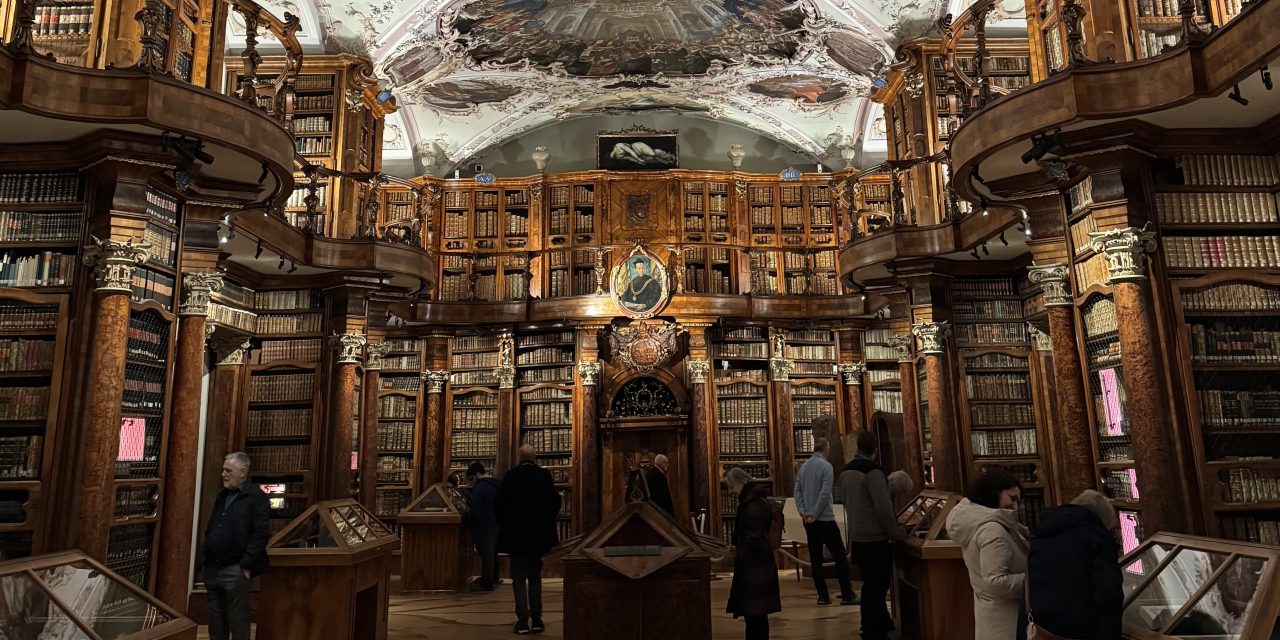
At the heart of the weekend was a trip to see the abbey library. The library dates back to the 18th century, although its origins date right back to the 8th century, by which stage the monastery already had a significant collection of books. The current library has more than 170,000 books, of which around 400 are more than 1,000 years old. It is on almost every list of the most beautiful libraries in the world and is somewhere I’d wanted to see for a while.
We started in the exhibition space to see the Abbey Plan. This astonishing document shows an original design and concept for an entire monastery compound, drawn onto parchment in around 820AD. As you’d expect for a document this old and precious, it’s incredible carefully managed. A darkened auditorium with a model abbey in the centre plays a film explaining the history of the plan and then, through the story of fictional monk Uto, shares how life might have been for a monk had this monastery complex been built. Spoiler alert: Uto dies.
The plan itself is revealed at the end of the film, carefully hidden under the model abbey, which rises up for just 30 seconds to allow you to see these ancient documents before the they are covered again for protection from light. The ancient parchment is stitched together, red ink showing the plan for chapels, kitchens, stables, gardens – an abbey complex to house monks with everything they would need.
After the exhibition, the main event: the library. To get there, we walked back across the courtyard and through the arch into the middle of the cloisters. Remember that statue from last night? Well, it turns out that in the daylight, he wasn’t looking out at us. He’s looking down at a book. Trick of the light, a moment in the mist? Who knows – I’m not going back after dark!
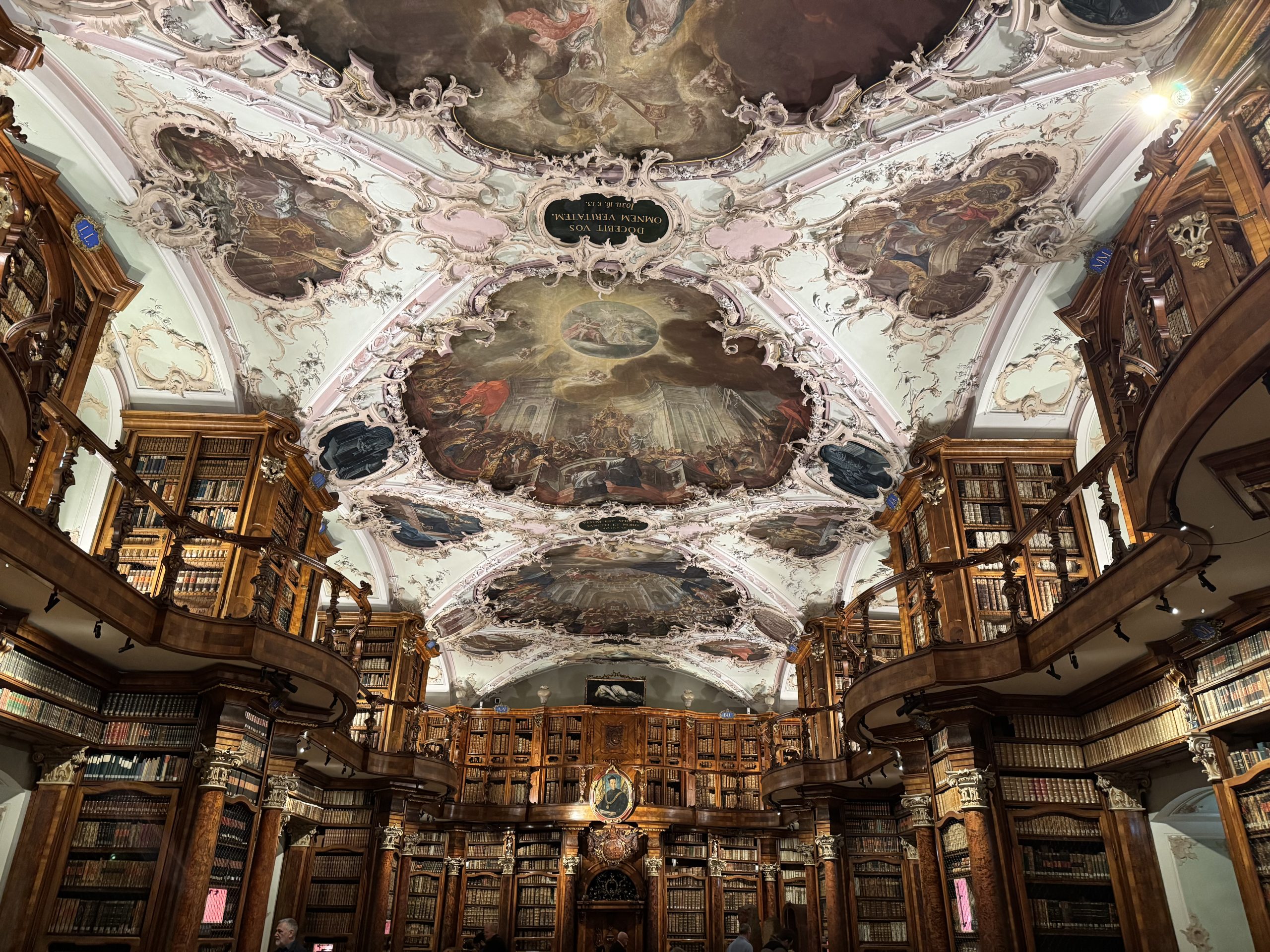
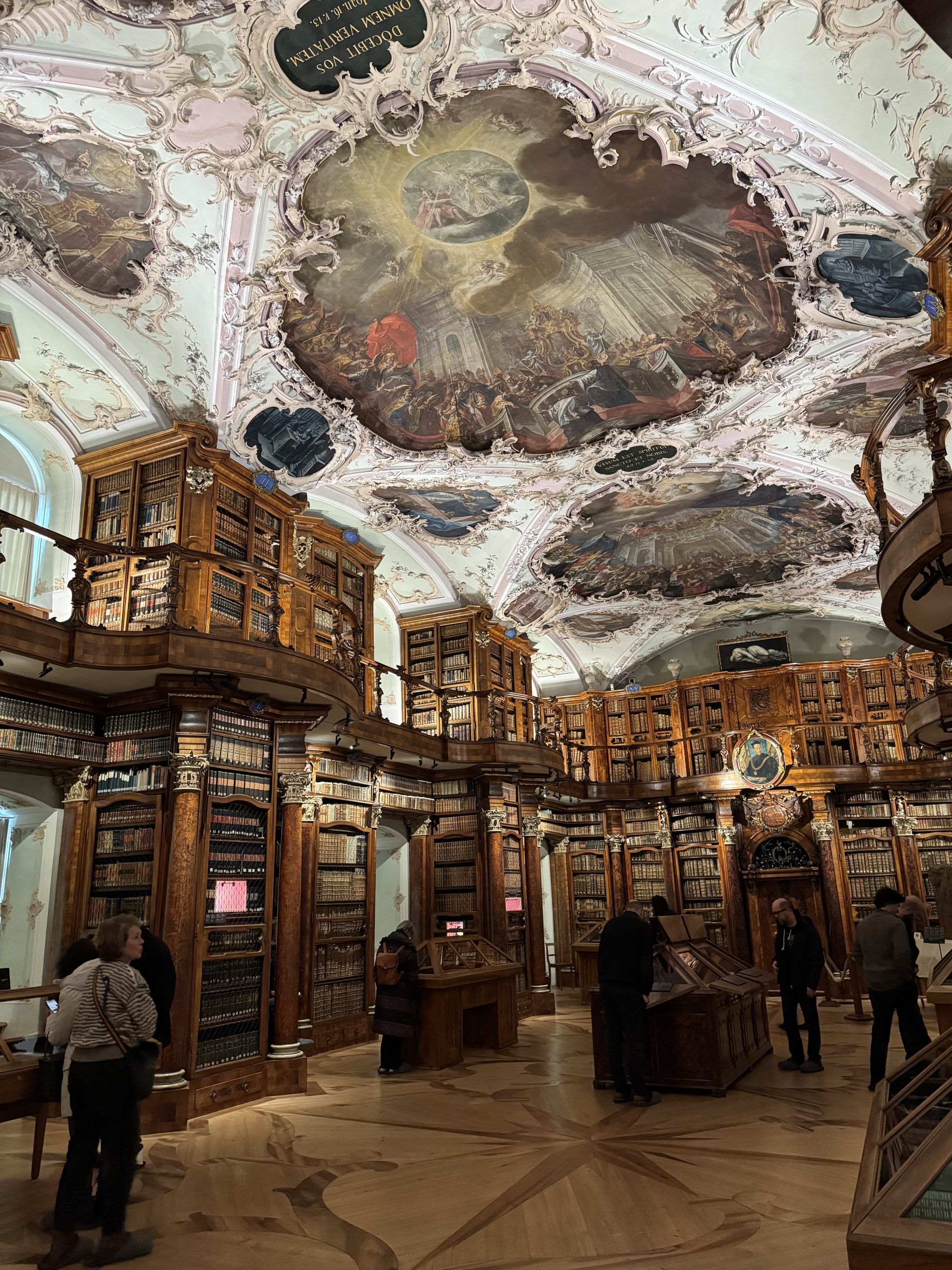
The outside of the building gives no clue as to what you’re about to see – simple, austere white stone. You enter a modern foyer, climb some stairs and put on giant felt slippers over your shoes. And then – the library. Via an ornate wooden door you enter a hall: books, polished wood, ornate decorations, painted ceiling, cherubs, curved intricate balconies – trying to work out what to look at first is almost a sensory assault.
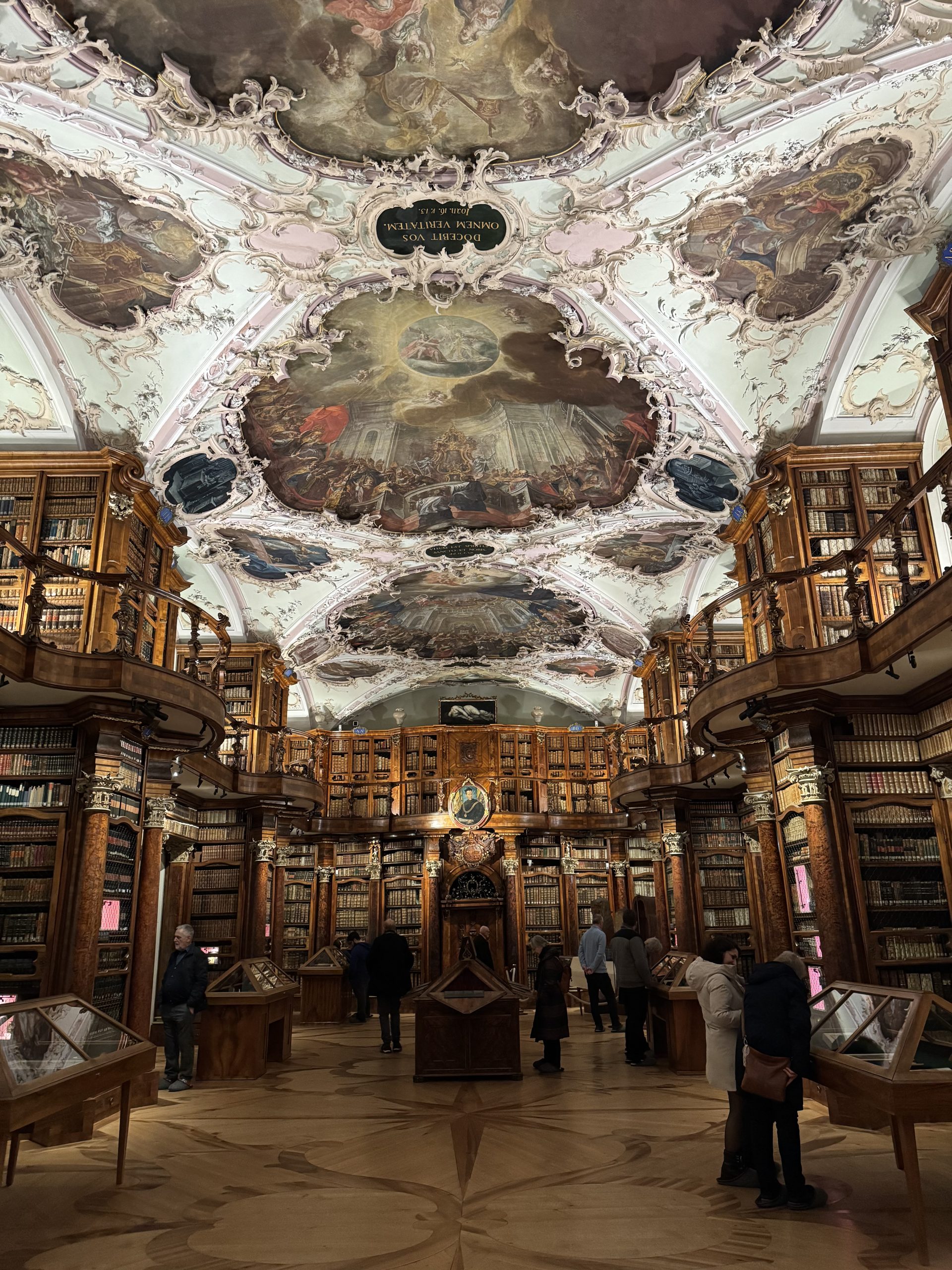
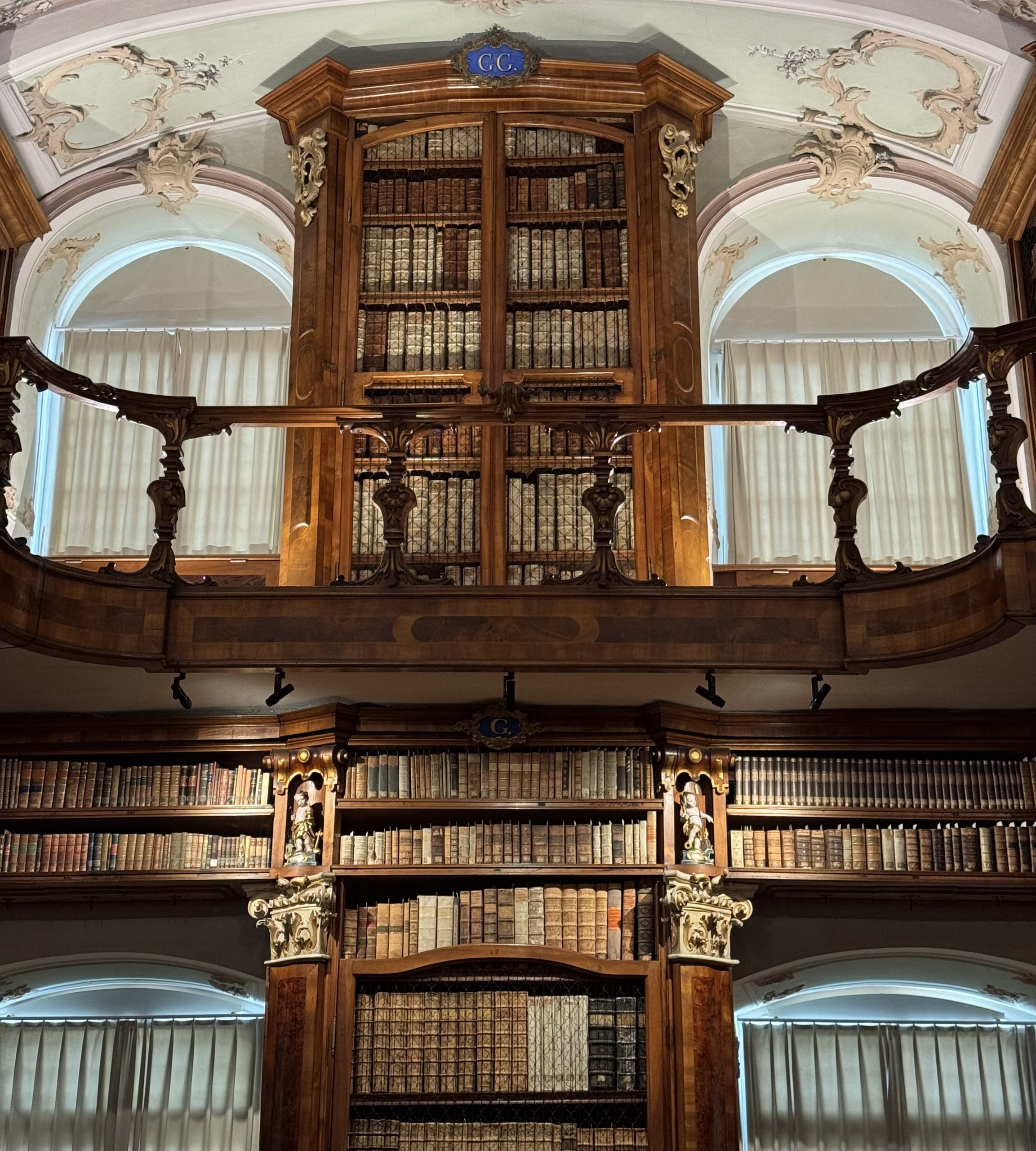
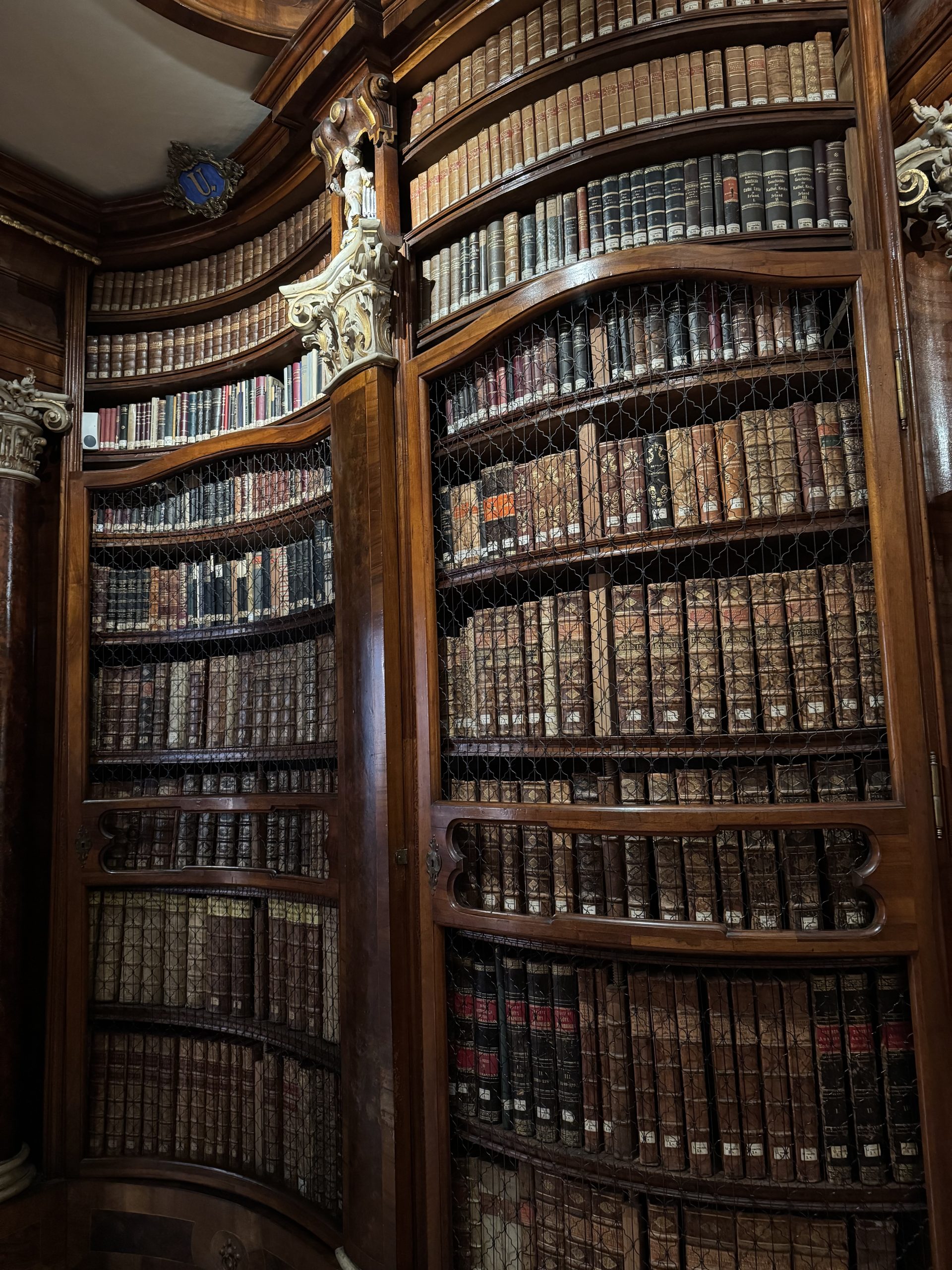
I tried to take in the details one at a time to make sense of everything we were seeing. Intricately carved, polished wooden shelves stretched from floor, up to high balconies, where even more books reached the ceiling. A thousand intricate details – every corner, curved shelf and railing was ornate, carved, decorated. Cherubs, gilt edgings, ornate plaques with gold lettering showing the alphabetical cataloguing of the books.
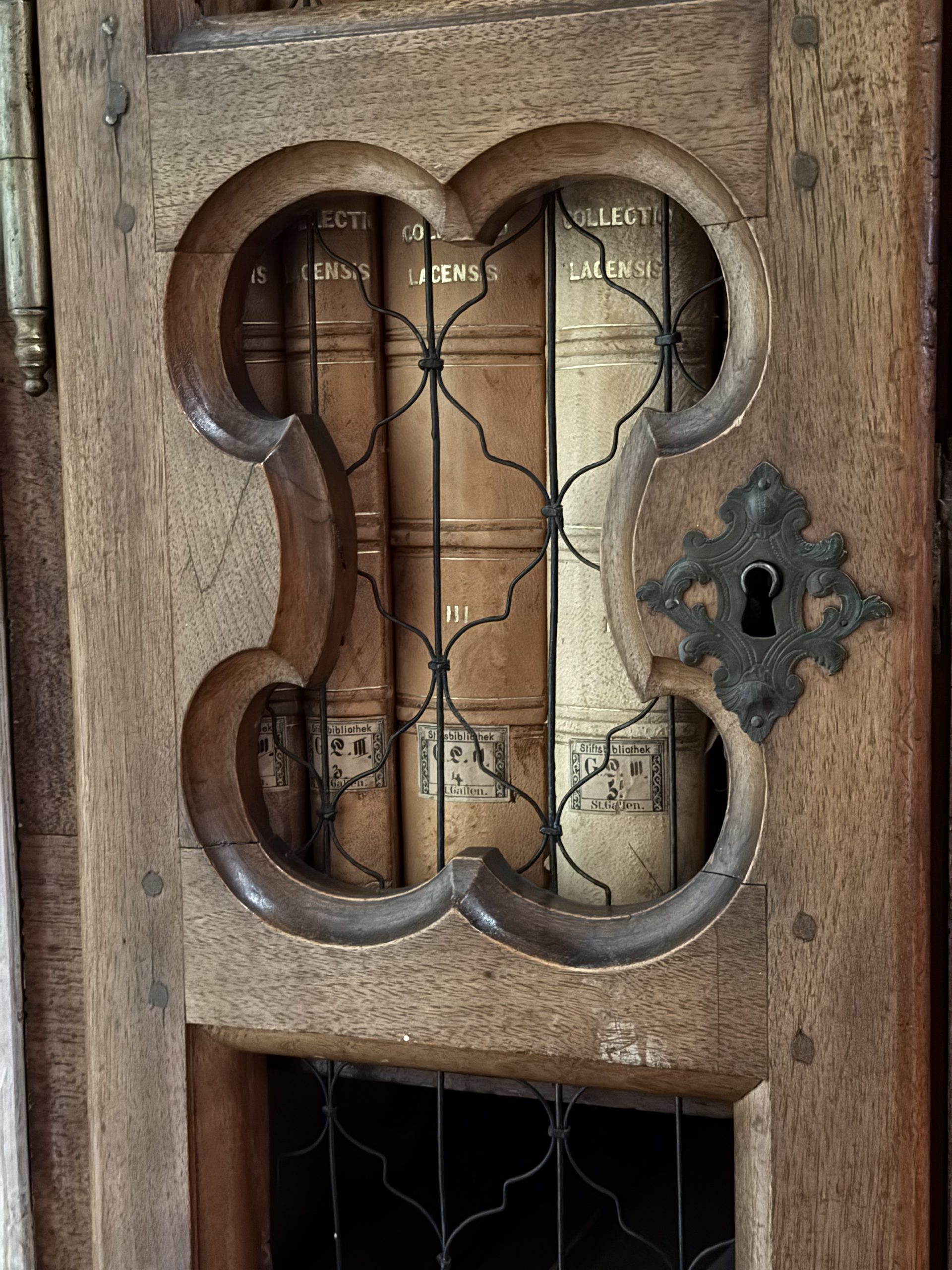
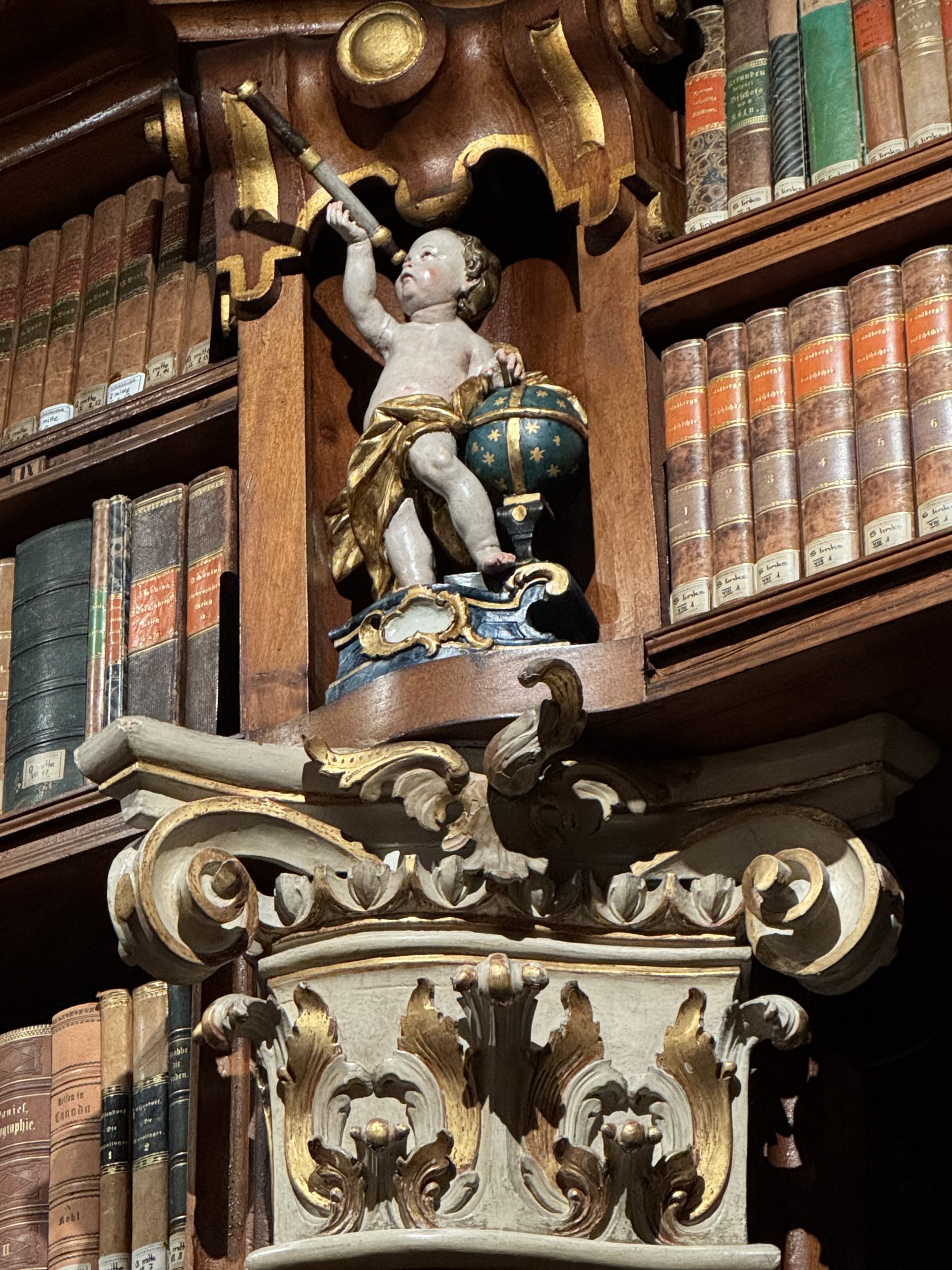
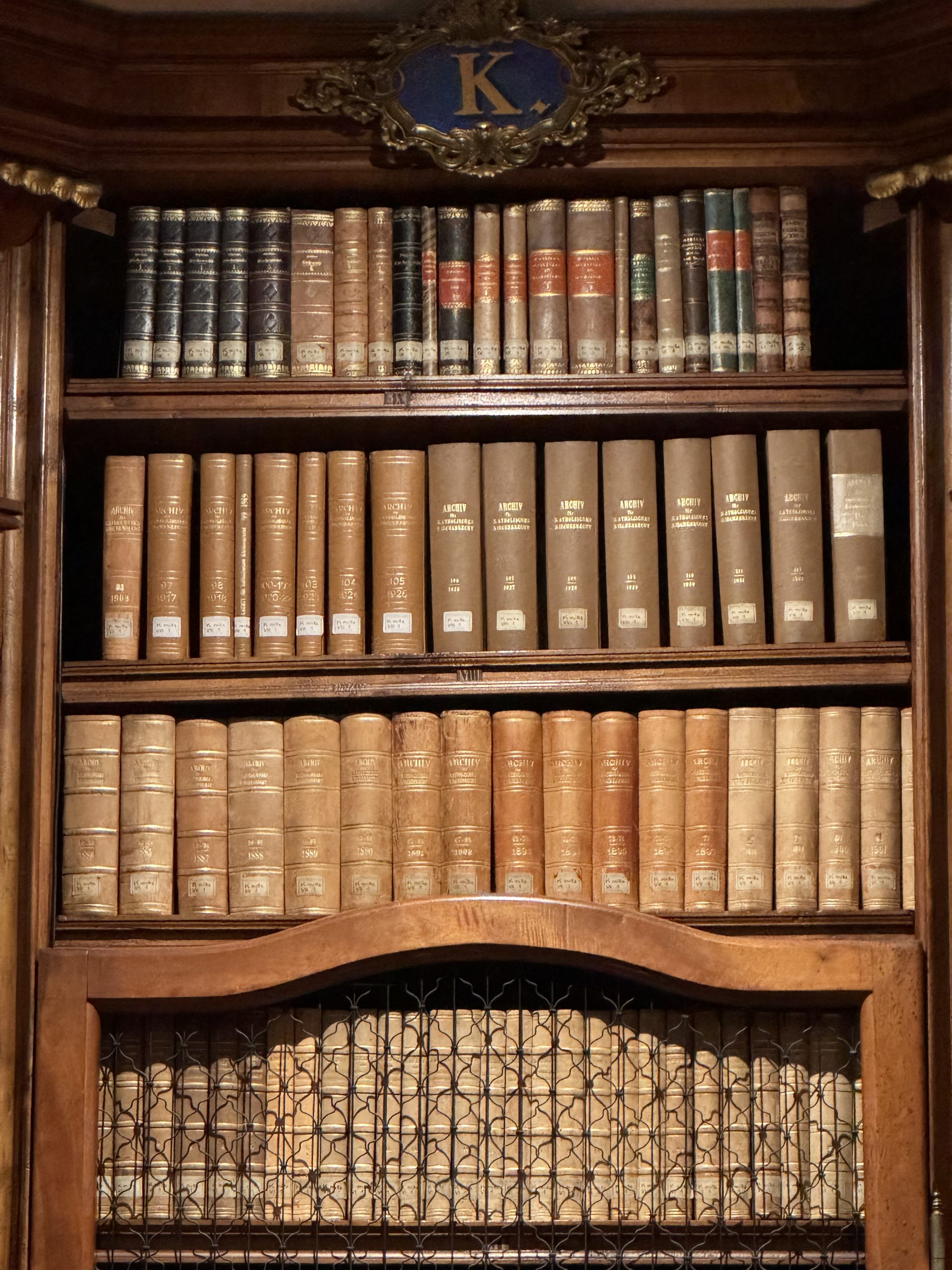
And – oh – the books! I’ve loved old books since I was a teenager and found the second-hand bookshop in Burford, saving up money from my Saturday job to buy old volumes of Dickens and Goethe (never read), searching for beautiful spines and gilt-edged pages, loving the smell of old paper and wondering at where the books had been and who they had belonged to. This library was a heaven of books of all sizes, from huge weighty tomes given pride of place on the bottom shelves, to the smaller books relegated to the top shelves out of sight. So much knowledge and wisdom, so much beautiful craftsmanship. Dusty cream spines, faded gold engraving, vibrant coloured volumes. I spent one happy turn of the room choosing my favourites (the red set, the turquoise set, the stunning black engraving).
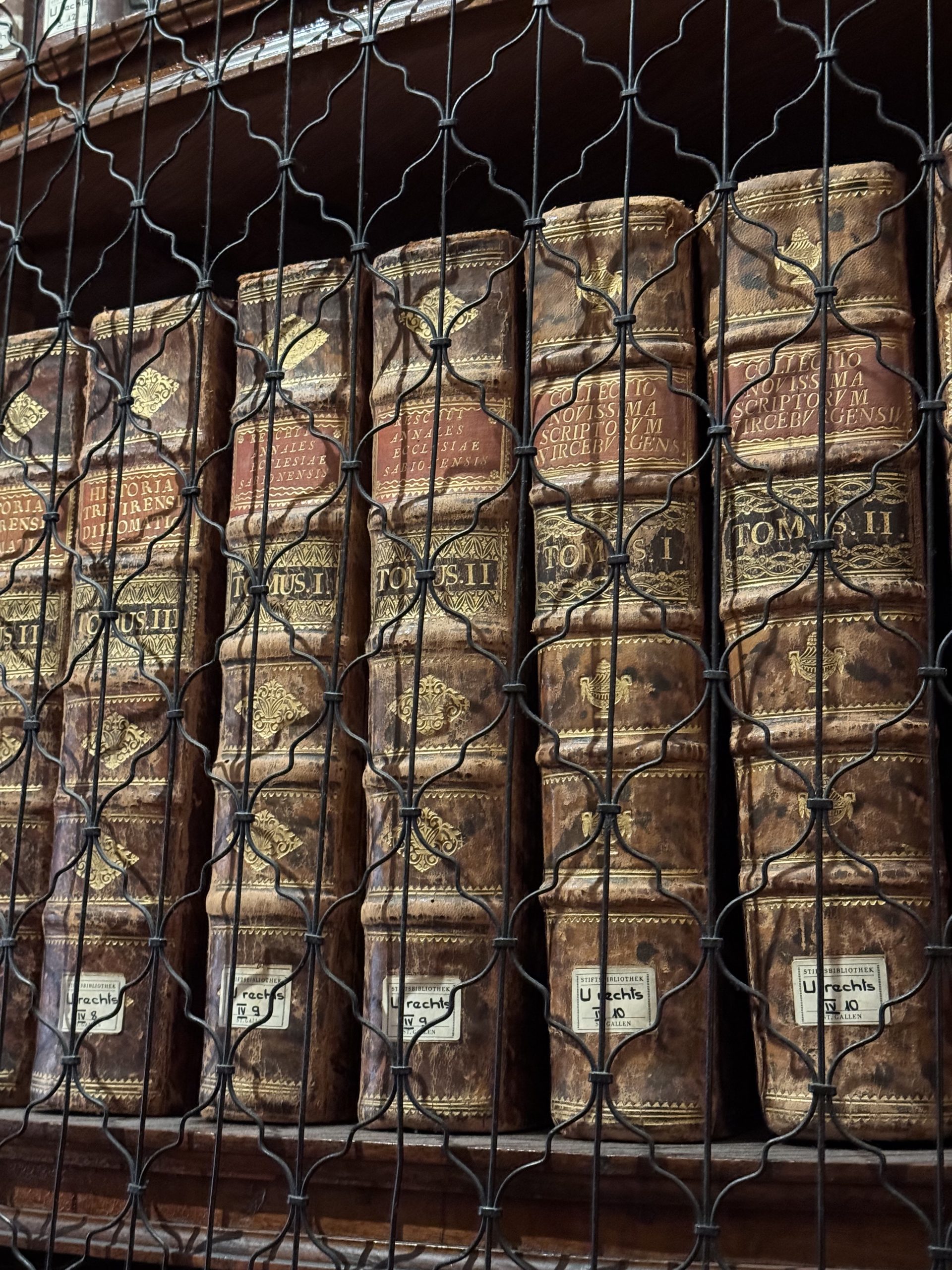
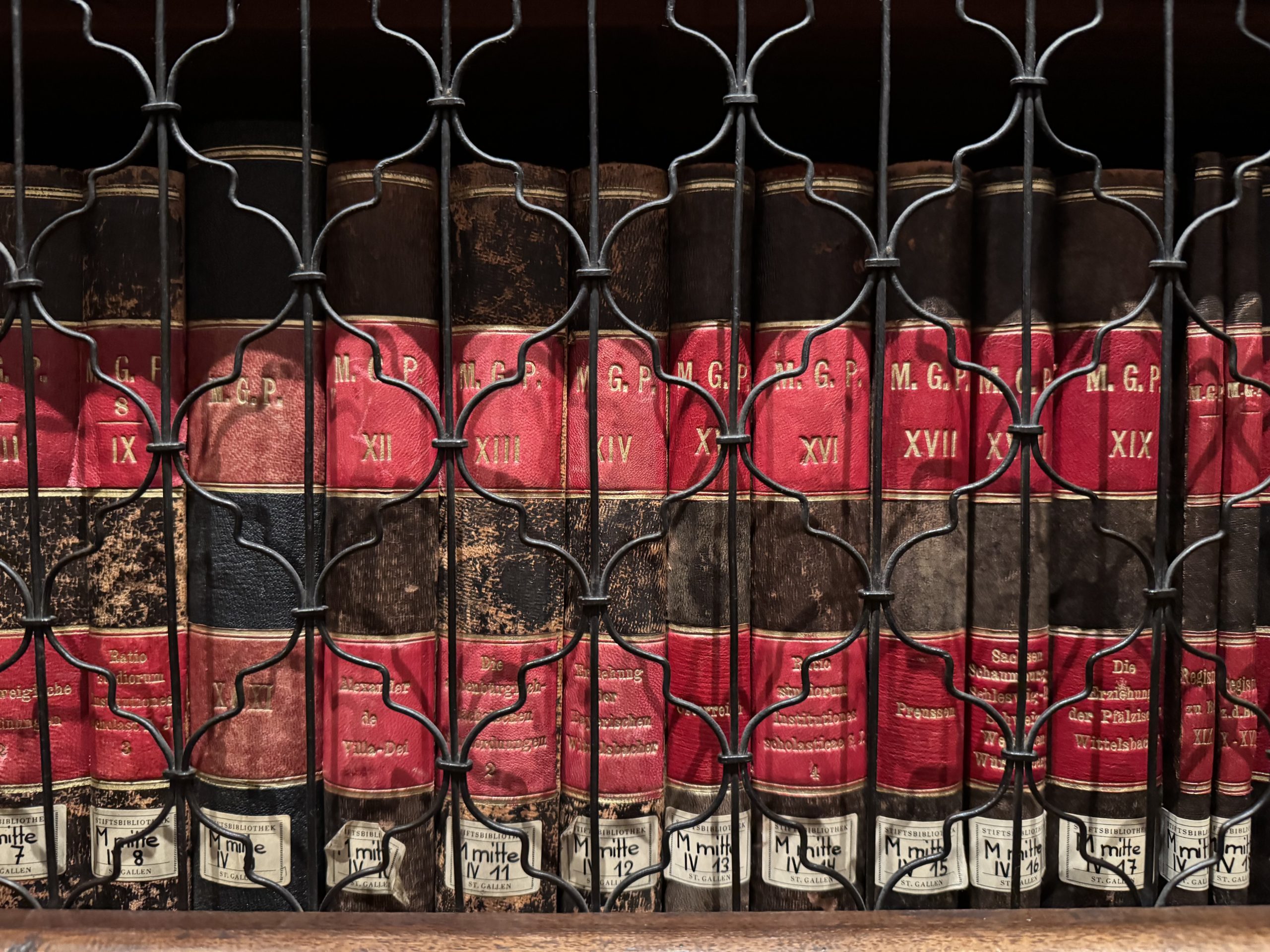
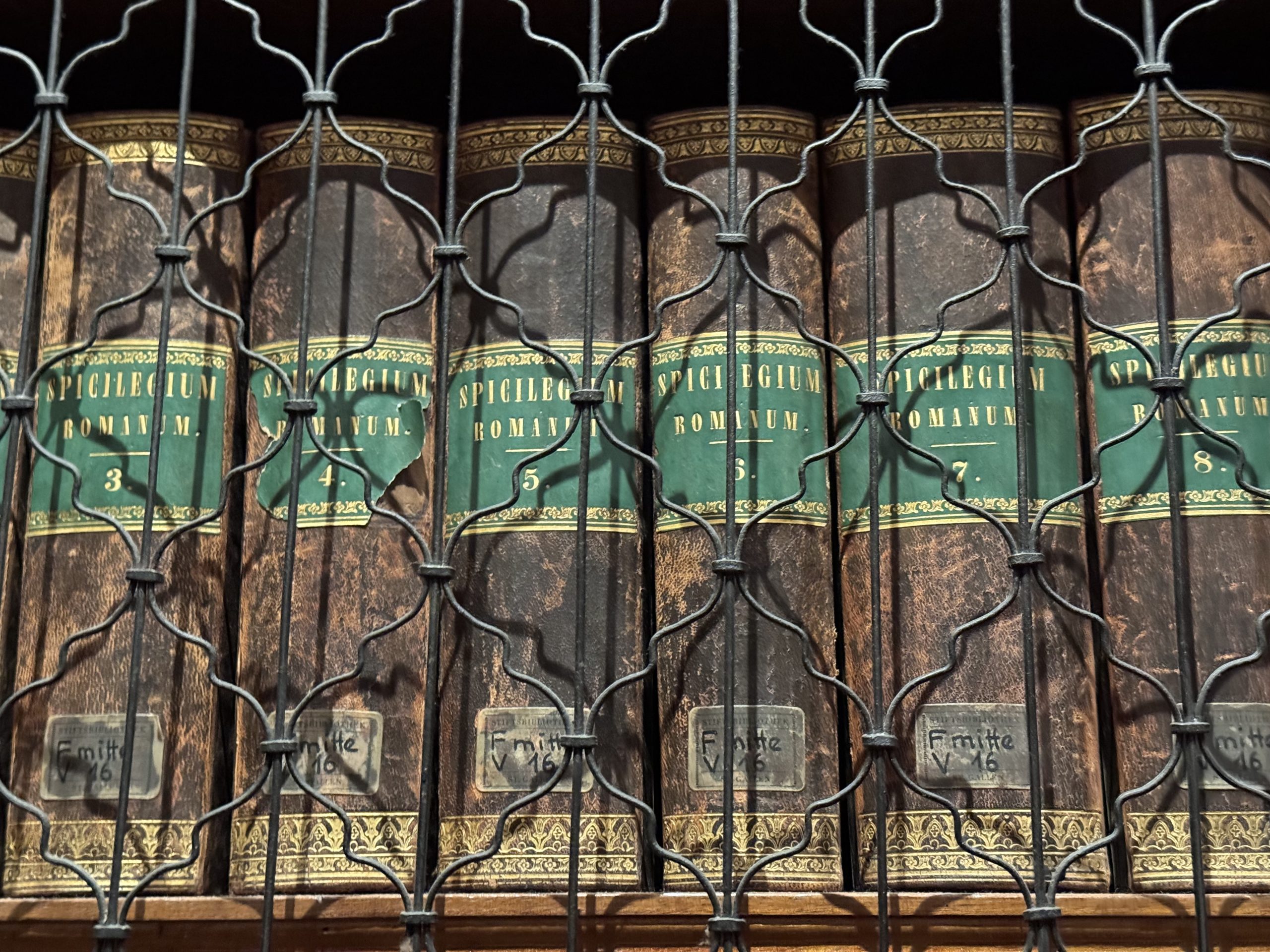
The ceiling could take a whole chapter of a book for itself. Painted frescos surrounded by ornate plasterwork in pastel pinks and greens, all scrolls and scalloped edges and overblown detail.
A galleried balcony runs around the whole room. More books and a hint of ornate staircases behind closed doors – how I would have loved to be allowed to sit up there!
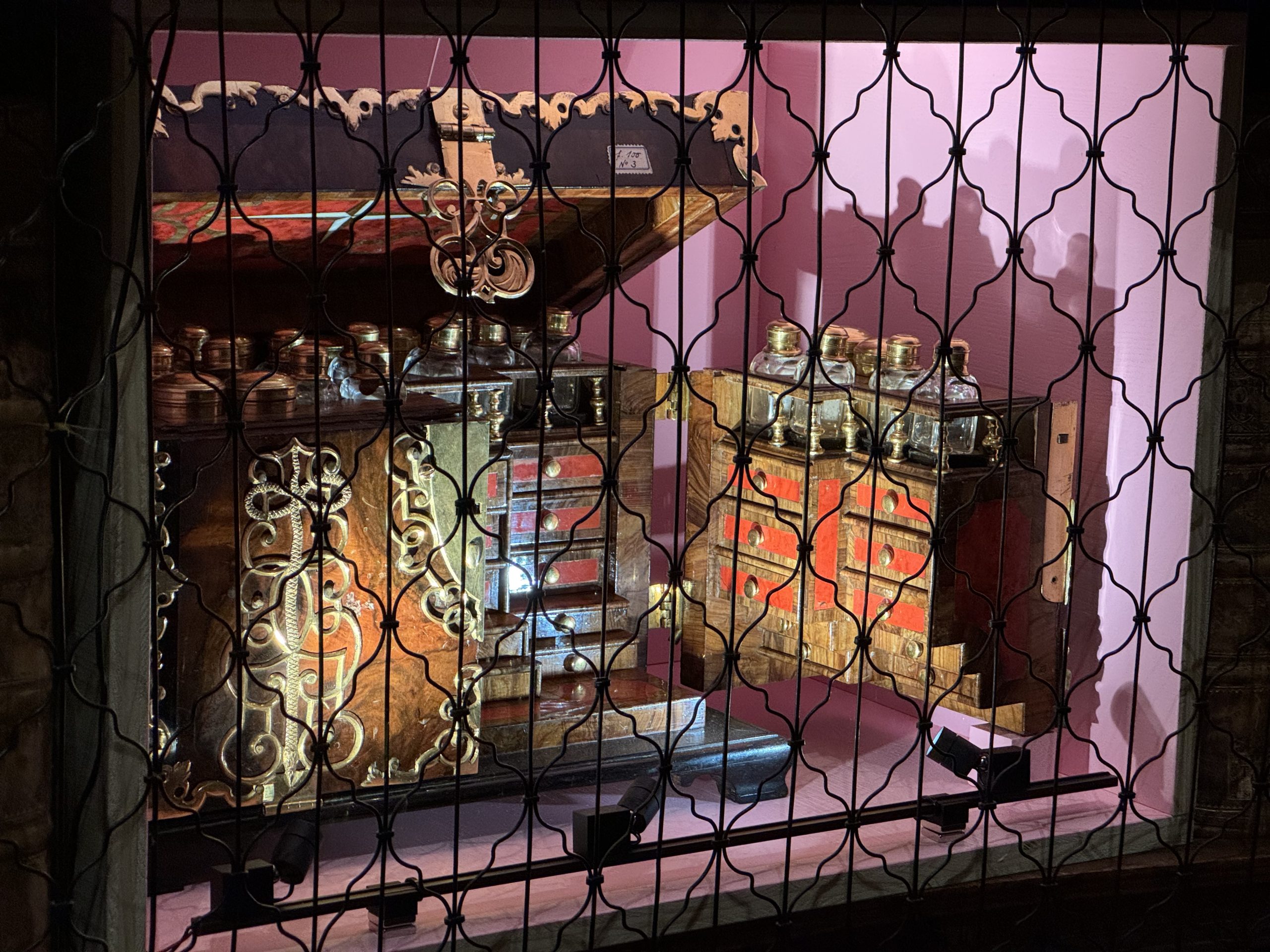
There’s also a whole bunch of exhibits from the abbey collection on display in the library. Artefacts collected on journeys. A 17th century travelling first aid kit – the most beautiful, bejewelled chest with tiny drawers to hold potions. So much more lovely than the functional red pouch we carry. Less practical in a rucksack though.
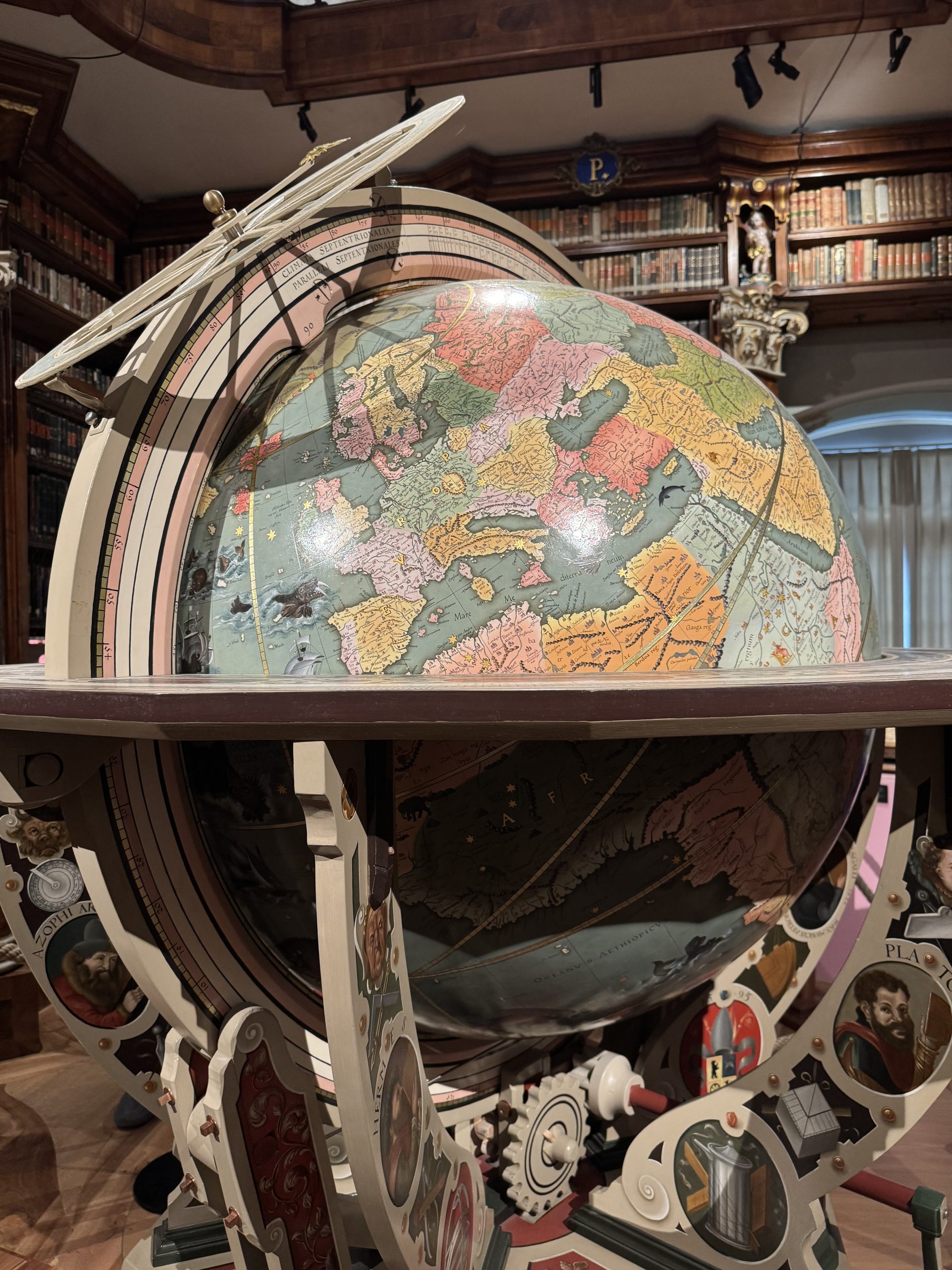
A giant (replica) globe – fascinatingly showing both earth and the stars, with huge swathes of the earth as yet uncharted. Star maps and tools for charting the heavens that reminded me of Philippa Pullman’s alethiometer. Cases with coins and books and maps. And then – astonishingly but also horrifyingly – in one corner there’s an Egyptian mummy. Inner and outer coffin standing behind, in a glass coffin lies the mummified body of Shep-en-Isis, believed to be a priest’s daughter from the 7th century BC who died aged around 30. She’s mostly covered, but with her head on display. Photos – quite rightly and reasonably – are not allowed so you’ll have to imagine this one. Incredible to see but I didn’t stay long – it jarred a little in this room of beautiful books for me, and some reading up afterwards suggests there’s a fair amount of debate over whether this is the resting place that’s right and fitting for her.
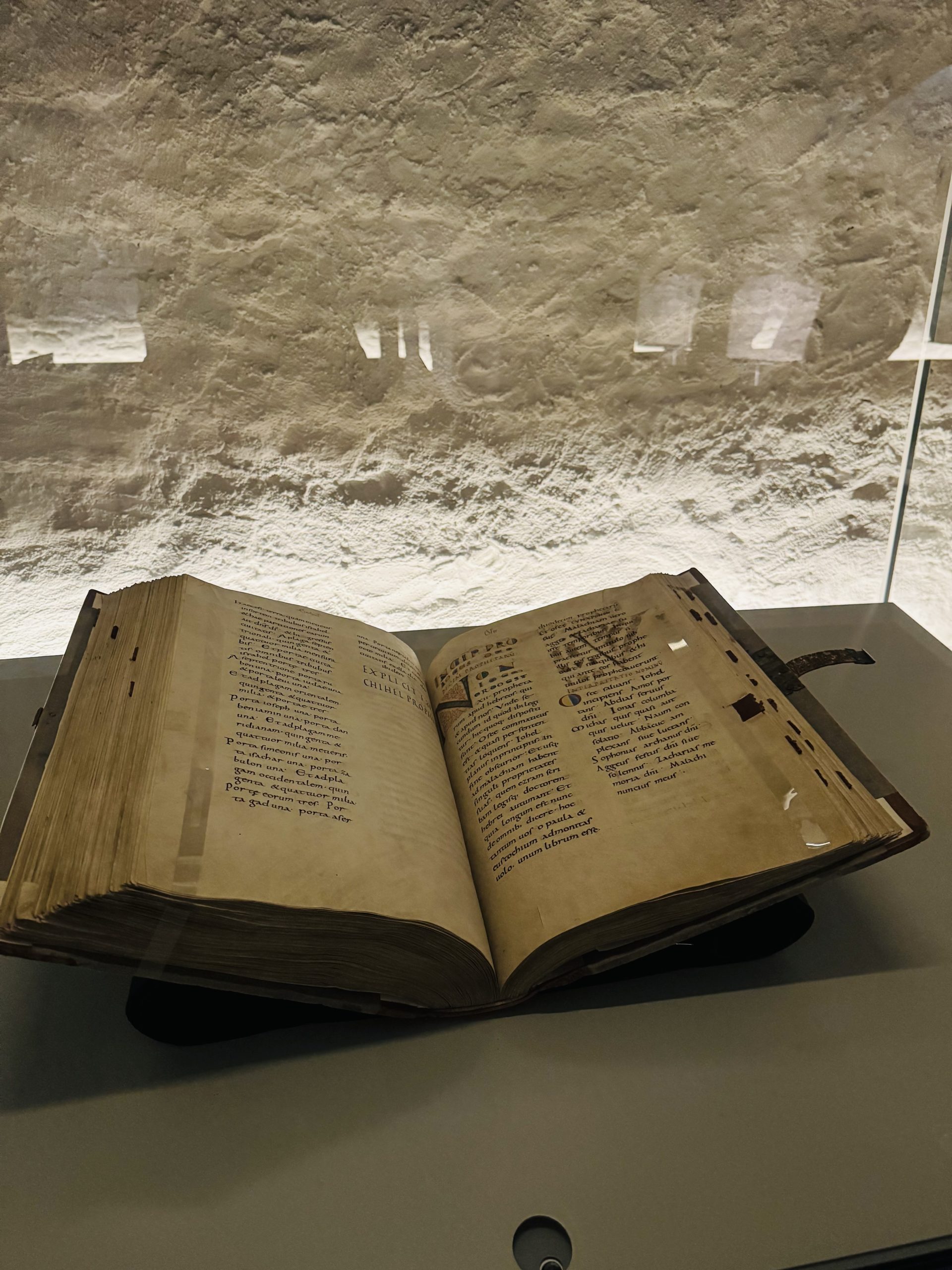
We tore ourselves away eventually and visited the vaulted cellar, where I learnt that 650 sheep were used to provide the parchment for the huge illuminated bible, one volume of which was on display. A lot of sheep.
After a long and lovely Greek lunch, all too soon it was time for Jo & Stephan to leave us and head home. Such a lovely chance to catch up with two of our favourite people. It felt odd to be just two again.
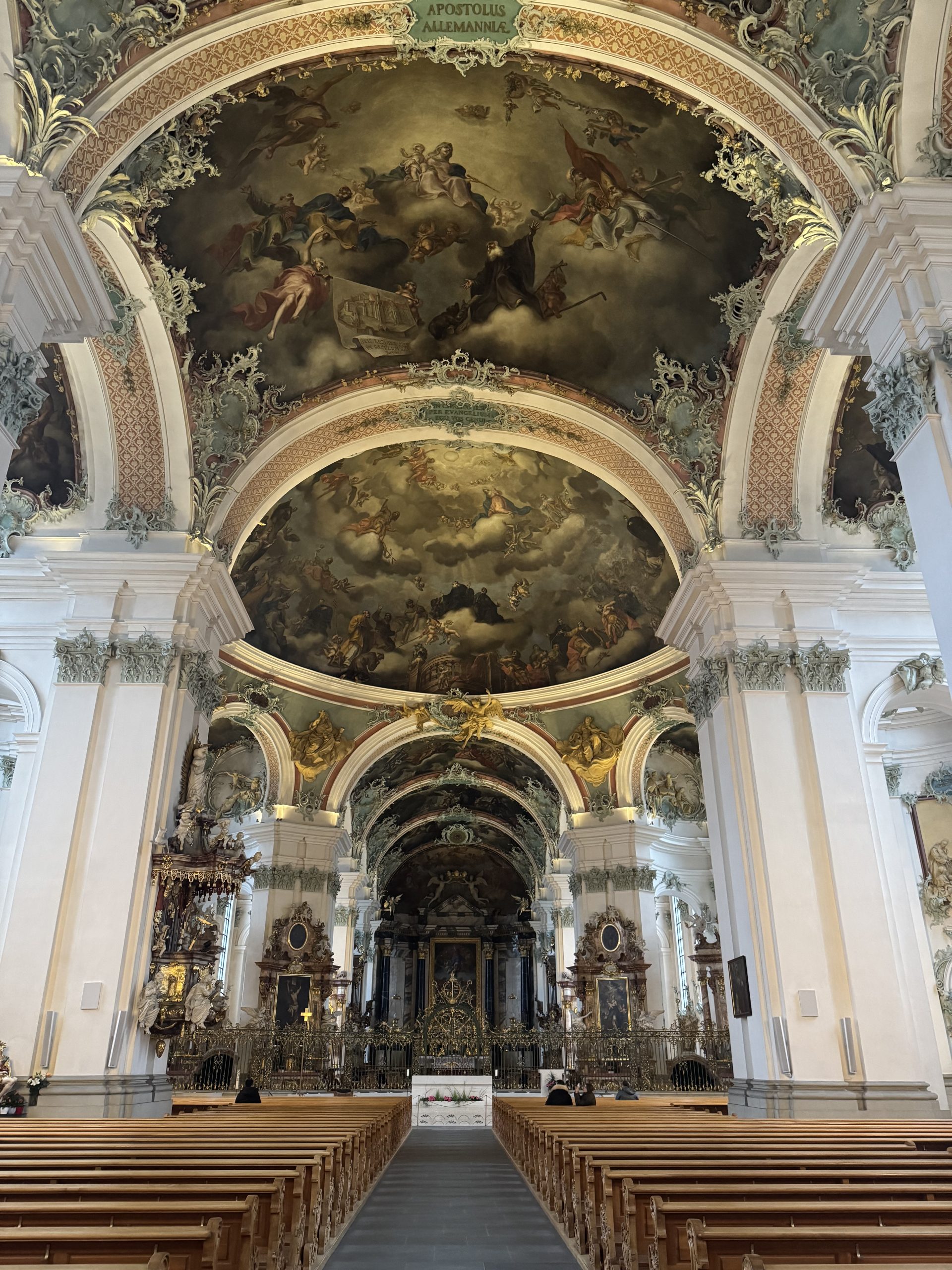
We headed out for a last walk in the dying afternoon light and St Gallen had two more surprises in store for us. The cathedral was open so we were able to go in for a short visit. Now the library made sense. Inside the austere building, an ornate, highly decorated interior. Domed ceiling painted with dark, stormy scenes, ornate framing, cherubs, intricate plasterwork – the two spaces echo each other in many ways.
I’d spotted a park on the map and picked it out as an objective for a walk. What I’d failed to notice was that it was at the top of a huge steep hill. However, as we reached the bottom of it, we found a small building housing the bottom station of an unmanned funicular. Buy a ticket, hit the call button, jump in when it arrives and hit go – an outdoor lift. We should have walked up but this was too good to miss. At the top, the world was snowy, the ponds frozen and the view back over St Gallen misty and serene. The lights below came on as we walked and the sunset faded to dusk.
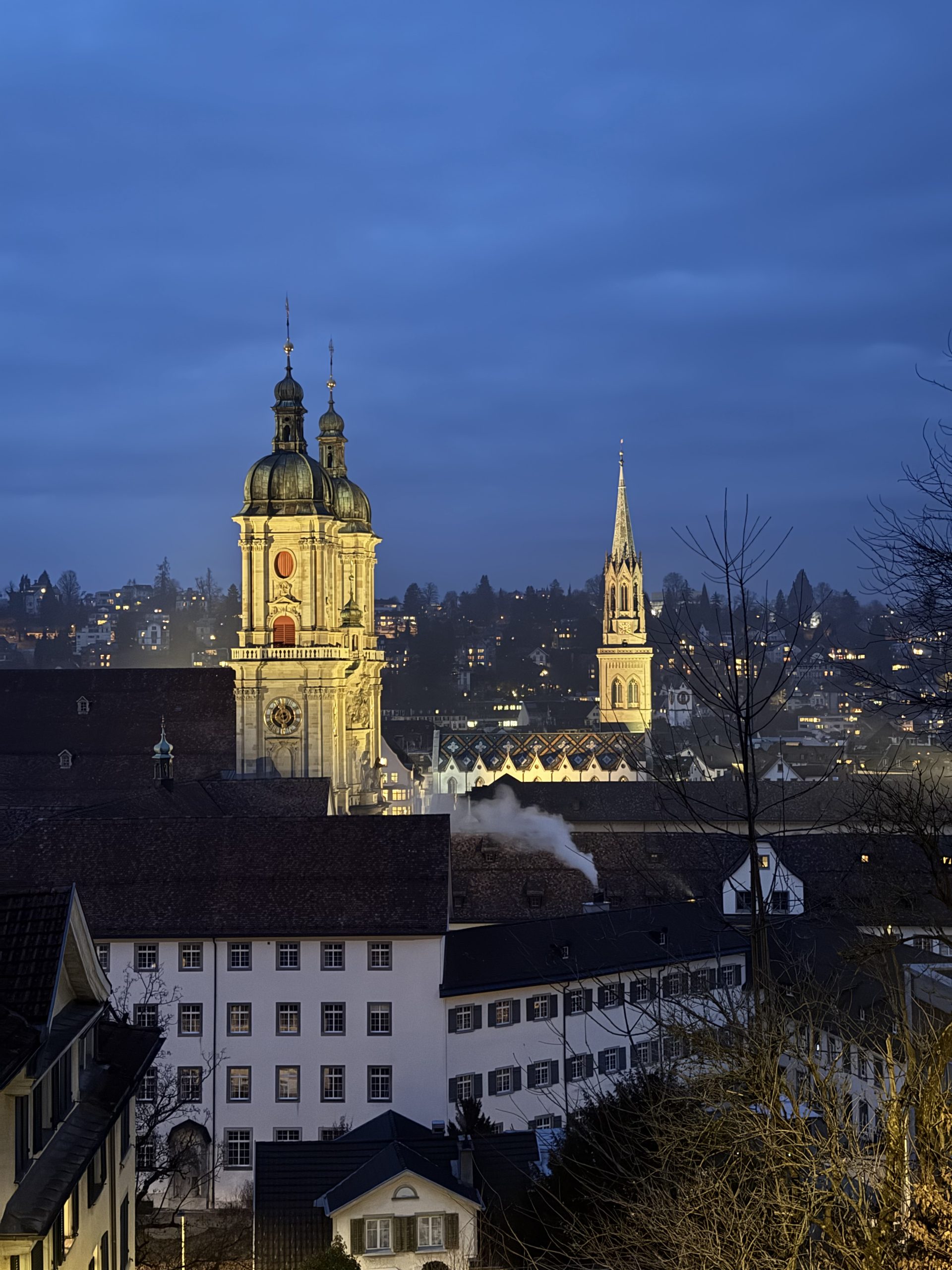
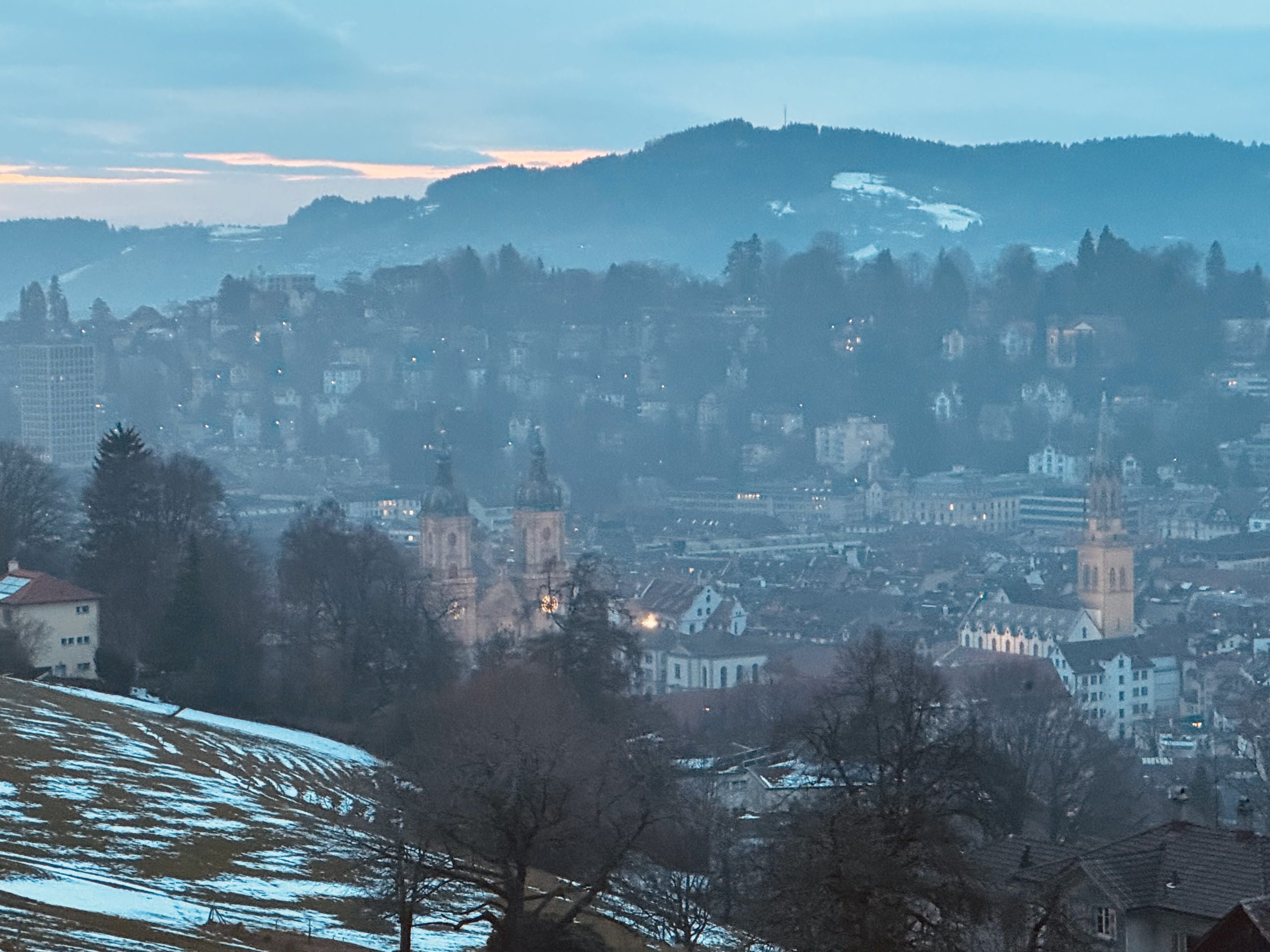
What a lovely, special city – so under the radar when people talk about Switzerland, yet so much to see and do. Atmospheric, beautiful, walkable and interesting, with great cafes and bars to relax in between explorations. Centuries of learning and scholarship, and a sense of timelessness of history. A great base for a weekend – and another highly recommended spot to visit.